TECHNICAL GUIDE · PORT FITTINGS & THREADS · HYDRAULIC LIFT CYLINDERS
Hydraulic Cylinder Port
Fittings and Thread Guide
BSPP · SAE · Metric · JIC
The port fitting is where every hydraulic hose connects to the hydraulic lift cylinder — and where the majority of hydraulic system leaks originate. A mismatched thread on a lift cylinder port, incorrect seal, or wrong port size can produce a leak on first pressurisation or only appears weeks later as the fitting gradually backs off under vibration. This guide covers the four principal thread standards used in lift cylinder ports — BSPP, SAE ORFS, metric, and JIC thread — including identification methods, sealing mechanisms, correct torque values, and the most common installation errors for each type.
SAE ORFS
Metric · JIC
LIFT CYLINDERS · PORT FITTING ENGINEERING · JULY 2026
REFERENCE · LIFT CYLINDER PORT THREAD QUICK IDENTIFICATION
BSPP (G-thread)
Parallel
UK/EU/Asian standard — parallel thread, bonded seal or O-ring face sealing. Most common on European and Chinese-built lift cylinders
SAE ORFS
O-ring face
USA standard — flat face with O-ring groove; most reliable seal for high-pressure lift cylinder applications in North America
METRIC (DIN)
Parallel
German/European DIN standard — metric parallel thread with O-ring face seal or bonded seal. Common on European-manufactured lift cylinders
JIC (37° FLARE)
Taper seat
USA thread with 37° internal taper seat — metal-to-metal seal. Used on tube connections and some USA lift cylinder ports
SECTION 01
Thread Type Identification and Regional Standards
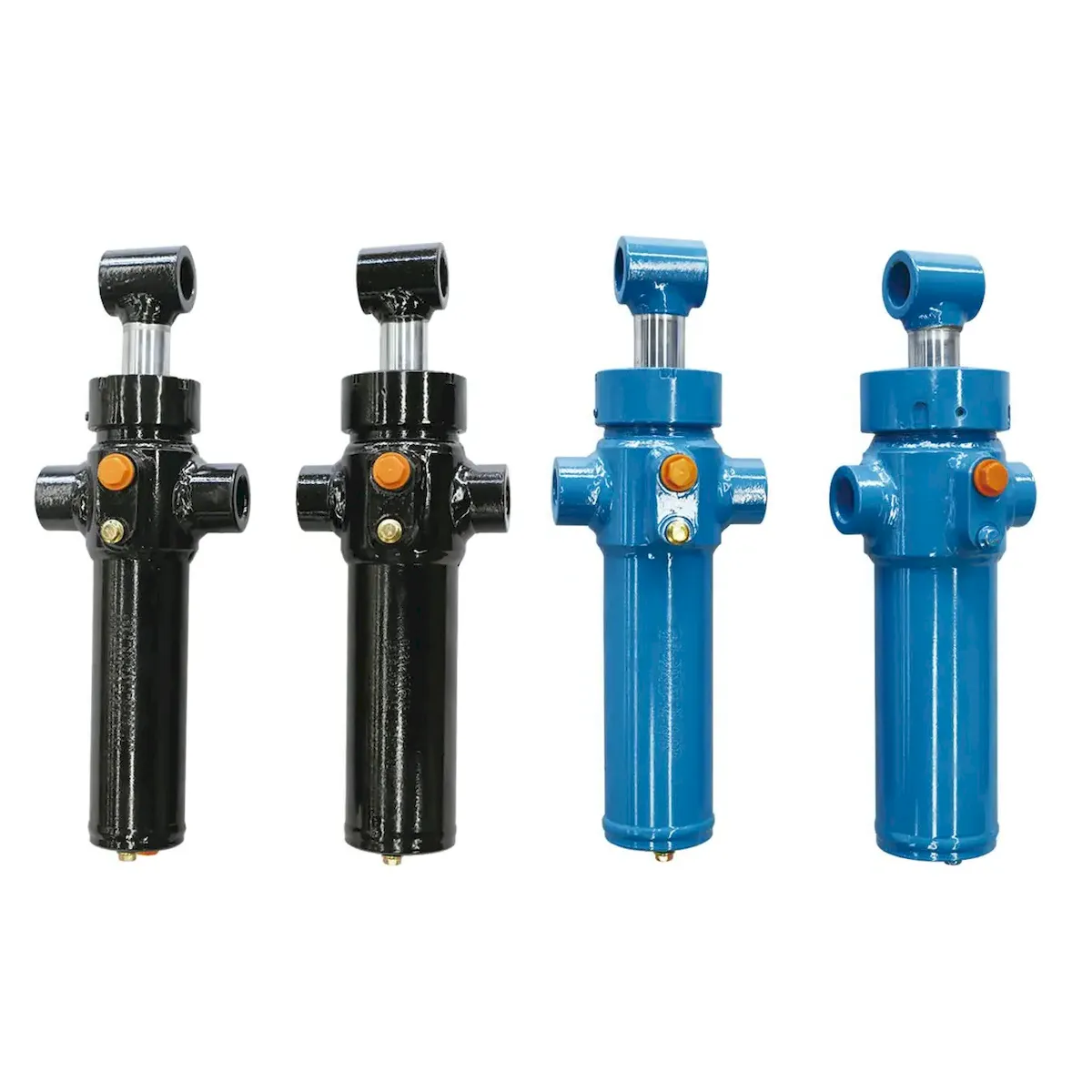
Identifying the correct thread type on an existing lift cylinder port before ordering replacement fittings prevents the most common and costly port connection error. The four steps to positive thread identification:
STEP 1
Measure the thread pitch. Use a thread pitch gauge — a set of bladed gauges that match thread crests. BSPP G1/2″ has 14 TPI (threads per inch). SAE ORFS 1/2″ has the same 14 TPI. Metric M22×1.5 has 1.5 mm pitch. The pitch measurement alone is not sufficient to distinguish BSPP from SAE at the same size — you must also check the face geometry.
STEP 2
Inspect the port face geometry. Look into the port with a bright light. BSPP ports may have a chamfered face (for a bonded washer seat) or a flat face (for an O-ring face seal fitting). SAE ORFS ports have a distinctive flat face with a recessed O-ring groove that is visible and measurable. JIC ports have a machined 37° internal taper cone. Metric ports look similar to BSPP — differentiate by thread pitch measurement.
STEP 3
Measure the thread outer diameter. Use a calliper on the thread crests. BSPP G1/2″ OD = 20.96 mm; SAE ORFS 1/2″ OD = 20.96 mm; Metric M22 OD = 22.00 mm. The OD measurement is the most reliable differentiator between BSPP and SAE ORFS (they have the same nominal thread but different face geometry) and metric (different OD). Combined with the face geometry check, this produces a positive identification.
STEP 4
Check regional origin. A lift cylinder manufactured in the UK, Europe, or China will almost always use BSPP (G-thread) ports as the standard. Any lift cylinder from North America will typically use SAE ORFS. A cylinder from Germany or central Europe may use DIN metric ports. If you have the original cylinder’s datasheet or product code, the port specification is usually listed — contact the lift cylinder manufacturer with the serial number if in doubt.
SECTION 02
BSPP Ports — Sealing Methods and Installation
BSPP is the most widely used port thread standard on lift cylinders manufactured in the UK, Europe, and China. The thread is parallel — it does not seal by thread engagement alone and requires a separate sealing element at the port face. Three sealing methods are used with BSPP ports:
BONDED SEAL (DOWTY WASHER)
A metal washer with a vulcanised rubber ring on its inner face seals against the machined face at the port entry. The bonded seal is compressed as the fitting is tightened, creating a seal between the fitting face and the port seat. Advantages: tolerates minor face surface irregularities; easy to replace if damaged. Disadvantages: the bonded seal retains its position only as long as the fitting is tight — if the fitting loosens, both the seal and the hydraulic pressure are lost simultaneously. Maximum rated pressure: 30 MPa.
O-RING FACE SEAL ON BSPP
A BSPP fitting with a machined flat face and an O-ring groove on the fitting face mates with a flat face on the lift cylinder port. The O-ring is compressed between the two flat faces as the fitting is tightened. This seal is more reliable than the bonded washer because the O-ring stays in its groove even before the lift cylinder fitting reaches final torque — it provides some leakage resistance during assembly before the final torque is applied. Maximum pressure: 35 MPa for the standard O-ring.
PTFE TAPE — DO NOT USE
PTFE thread tape is incompatible with BSPP parallel thread hydraulic ports. A BSPP thread is parallel — it cannot create a thread-taper seal as a BSPT (tapered) thread does. PTFE tape on a parallel thread provides no sealing function and can fragment under high-pressure cycling, introducing PTFE contamination into the lift cylinder bore and hydraulic circuit. PTFE tape belongs only on BSPT tapered connections — never on hydraulic lift cylinder BSPP ports.
SECTION 03
SAE O-Ring Face Seal — The Preferred High-Pressure Solution
The SAE J1926 O-ring face seal (ORFS) is consistently cited in field reliability studies as the hydraulic port connection type with the lowest leak rate of any thread standard, particularly in high-pressure and high-vibration environments. Lift cylinders for North American mobile equipment and reliability-critical international projects are increasingly specified with ORFS ports:
WHY
ORFS?
The ORFS advantage comes from two features that eliminate the most common failure modes of other thread types: (1) the O-ring is retained in the fitting face groove before connection — it cannot fall out during assembly, and its position is fixed relative to the fitting regardless of rotation; (2) the metal-to-metal face contact at correct torque prevents the O-ring from being over-compressed — the fitting bottoms on the flat face before the O-ring reaches damaging compression. Both features make ORFS more tolerant of installation by personnel unfamiliar with hydraulic fitting procedures than any other thread type.
ORFS
SIZES
SAE ORFS sizes are designated by nominal port size in inches and thread specification: -4 ORFS (7/16-20 UNF), -6 ORFS (9/16-18 UNF), -8 ORFS (3/4-16 UNF), -10 ORFS (7/8-14 UNF), -12 ORFS (1 1/16-12 UN), -16 ORFS (1 5/16-12 UN). The lift cylinder port is machined with a flat face and counterbored O-ring groove — this machined seat is the critical feature that distinguishes ORFS from a standard flat-face BSPP port. The groove dimensions are defined in SAE J1926 and are not interchangeable with any other fitting standard.
ORFS
ERROR
The most common ORFS installation error is installing the fitting without the O-ring — particularly when replacing an O-ring that was stuck to the old fitting face and removed with the fitting rather than remaining in the groove. An ORFS fitting tightened without its O-ring will appear correctly installed but will leak immediately under pressure — the metal-to-metal face contact alone does not seal. Always confirm the O-ring is in the fitting groove before threading any ORFS connection into a lift cylinder port.
All standard lift cylinders in the product range are available with BSPP G-thread (standard) or SAE ORFS ports on request — specify the port standard at order placement. The port standard on a lift cylinder cannot be changed after manufacture without re-machining the end-cap.
SECTION 04
Metric and JIC Thread Ports
Metric and JIC threads are less common on standard lift cylinders but appear on specific machine types and in specific regional markets:
| TYPE | THREAD | SEALING | COMMON ON | MAX PRESSURE |
|---|---|---|---|---|
| Metric DIN (ISO 6149) | M12–M52, fine pitch | O-ring in counterbore at port face | German/central European lift cylinders, hydraulic manifolds | 40 MPa |
| JIC 37° flare (SAE J514) | UNF thread, 37° cone | Metal-to-metal 37° taper seat contact | USA fluid power tube fittings, some cylinder ports | 21 MPa (flareless), 35 MPa (flared) |
| NPT/NPTF tapered thread | Tapered 60° thread | Thread taper interference (NPTF) or with PTFE tape (NPT) | USA plumbing-originated equipment, old agricultural lift cylinders | 21 MPa (not recommended for new high-pressure designs) |
JIC vs BSPP confusion: JIC and BSPP G-thread are frequently confused because both use UNF-type thread pitches and both are used in the same size range. A JIC fitting will appear to engage a BSPP port and vice versa — the thread pitches are close but not identical in all sizes, and the face geometries are completely different. A JIC fitting forced into a BSPP port will damage the 37° seating face of the JIC fitting against the flat BSPP face — producing a connection that appears assembled but leaks immediately under pressure. Always identify the port thread type before selecting fittings for any lift cylinder port connection.
SECTION 05
Port Torque Reference Table
Every hydraulic fitting must be installed to the correct torque — insufficient torque allows leakage; excessive torque cracks the port boss or deforms the seal seat. Use a calibrated click-type torque wrench — hand tightening is not an adequate substitute for any application above low pressure:
| THREAD / SIZE | STANDARD TORQUE | MAX TORQUE | SEAL TYPE |
|---|---|---|---|
| BSPP G1/4″ | 20 Nm | 25 Nm | Bonded seal or O-ring face |
| BSPP G3/8″ | 35 Nm | 45 Nm | Bonded seal or O-ring face |
| BSPP G1/2″ | 55 Nm | 70 Nm | Bonded seal or O-ring face |
| BSPP G3/4″ | 90 Nm | 110 Nm | Bonded seal or O-ring face |
| BSPP G1″ | 135 Nm | 165 Nm | Bonded seal or O-ring face |
| SAE ORFS -6 (9/16-18) | 30 Nm | 38 Nm | O-ring in fitting face groove |
| SAE ORFS -8 (3/4-16) | 50 Nm | 62 Nm | O-ring in fitting face groove |
| SAE ORFS -12 (1 1/16-12) | 120 Nm | 145 Nm | O-ring in fitting face groove |
These torque values apply to standard steel fittings in lift cylinder ports with a clean, dry thread and a new sealing element. For stainless steel fittings in stainless ports, reduce torque by 10%. Always re-torque all fittings to the correct value after the first 10 pressure cycles on a new installation — hydraulic fittings relax slightly as the seal and thread contacts bed in. For the correct port specification on any lift cylinder in the industrial engineering hydraulic cylinder range, the lift cylinder port thread type, size, and face geometry are specified in the product datasheet.
SECTION 06
Common Port Installation Errors and Diagnosis
Four errors account for the majority of port leaks on new lift cylinder installations:
ERROR 1
MISSING SEAL
Fitting installed without bonded seal or O-ring. Diagnostic sign: leak appears immediately on first pressurisation, at the port face. The fitting is tight but oil seeps between the fitting face and the port. Resolution: depressurise, remove fitting, inspect for missing seal, install correct seal, re-torque.
ERROR 2
OVER-TORQUE
Excessive torque applied — port boss cracked or O-ring extruded. Diagnostic sign: port boss shows visible cracking around the thread entry; oil leaks from the cracked metal, not from the fitting face. On cast end-caps, over-torque can fracture the boss entirely. No field repair is possible for a cracked port — the lift cylinder must be replaced or the end-cap rebuilt.
ERROR 3
WRONG TYPE
JIC fitting in BSPP port (or vice versa). Diagnostic sign: fitting threads to different depth than expected; resistance before full thread engagement or no resistance at normal stop position; immediate seepage on pressurisation regardless of torque. Resolution: remove fitting, identify the correct port type following the four-step identification procedure, obtain the correct fitting.
ERROR 4
PTFE ON BSPP
PTFE tape applied incorrectly to a BSPP lift cylinder port. Diagnostic sign: fitting installed with PTFE tape visible at port entry; seeping at port face despite tape; PTFE fragments visible in oil filter after first pressurisation. Remove fitting, remove all PTFE tape residue from both thread and port, install a new bonded seal or O-ring face fitting, re-torque to specification. PTFE tape has no place on any lift cylinder BSPP port — it provides no sealing function on parallel threads.
TECHNICAL FAQ
Port Fitting Questions
Q 01
We are replacing a lift cylinder with a new unit from a different manufacturer — the new cylinder has BSPP ports but our existing hoses have ORFS fittings. What adapters are needed?
BSPP-to-ORFS adapters are standard catalogue items. The adapter threads into the BSPP port on the new lift cylinder and provides an ORFS face connection for the existing hose. The adapter must be the correct size — confirm both the BSPP port size (G1/4″, G3/8″, G1/2″, etc.) and the ORFS size (-4, -6, -8, etc.) of the existing hose fittings before ordering. Install the adapter into the BSPP port with a new bonded seal or O-ring to the BSPP torque specification, then connect the ORFS hose to the adapter at the ORFS torque specification. Do not try to mount the adapter without its BSPP seal — it will leak from the adapter’s BSPP thread side regardless of how tightly the ORFS hose is connected. If the new lift cylinder is a permanent installation rather than a temporary fix, it is worth specifying the replacement with the correct ORFS ports to eliminate the adapter — adapters add potential leak points and reduce the system’s cleanliness.
Q 02
A port on our lift cylinder has been cross-threaded by a previous technician — can it be repaired?
Mild cross-threading damage on a lift cylinder port — where only one or two thread crests are deformed — can sometimes be corrected with a thread chaser (a tap or die that cleans and reforms thread crests without removing material). A thread chaser, unlike a cutting tap, does not remove metal and is safe to use in a hydraulic port without risking size change. More severe cross-threading that has removed thread material requires re-machining the port to the next larger size and fitting a step adapter, or welding the damaged port and re-machining — both require the cylinder to be removed from the machine and taken to a hydraulic workshop. If the cross-threading is in the port boss and has cracked the boss material, the end-cap must be replaced. Cross-threaded ports are almost always the result of attempting to thread a fitting that did not start cleanly by hand — the fitting was either the wrong thread type or misaligned. The rule is: if any threaded connection does not start by hand in the first 2 threads without resistance, stop, remove, re-identify the thread type, and start again.
Q 03
Can we use Loctite thread sealant on a hydraulic port to stop a persistent weep that does not respond to re-torquing?
Anaerobic thread sealants such as Loctite 542 are compatible with BSPP parallel connections on a lift cylinder port and can resolve a persistent seep on a hydraulic lift cylinder port — but only as a last resort after the underlying cause has been identified and the port face and fitting face have been confirmed undamaged. The sealant fills micro-gaps in the thread and port face that the primary seal cannot bridge. Application: clean and degrease both threads and port face thoroughly; apply a thin ring of sealant to the fitting thread (not the port); assemble to the correct torque; allow 24 hours full cure before pressurising. Loctite hydraulic sealants are not a substitute for a correct sealing element — if the bonded seal or O-ring has failed (visibly cracked, missing, or extruded), replace it rather than adding sealant over a failed primary seal. And never use Loctite on an ORFS port — the ORFS face seal is designed for metal-to-metal contact with a retained O-ring; sealant contamination of the O-ring groove changes the contact geometry and can prevent the O-ring from seating correctly.
Q 04
We ordered a lift cylinder specified with BSPP G1/2″ ports but the blanking plugs supplied look like metric M22 — how do we tell which thread is actually in the cylinder?
BSPP G1/2″ and M22×1.5 ports on a lift cylinder are frequently confused — they look almost identical at a glance — both are parallel threads of similar outer diameter. The definitive distinction is thread pitch: BSPP G1/2″ has a pitch of 14 TPI (1.814 mm pitch); M22×1.5 has a pitch of 1.5 mm. Use a metric thread pitch gauge at the 1.5 mm blade and at 1.8 mm — only one will seat cleanly in the thread crests. A secondary check: the outer diameter of BSPP G1/2″ is 20.96 mm; M22 is 22.00 mm — a calliper measurement of the blanking plug threads will distinguish them. If the blanking plug supplied has the wrong thread, it may appear to thread into the port for 2–3 turns before binding — this is the thread-mismatch entry feel that indicates the wrong type. Never force a plug or fitting into a lift cylinder port that binds before fully seated. Contact the lift cylinder supplier with the serial number and request confirmation of the port specification — any reputable manufacturer can supply the correct information from their manufacturing records.
LIFT CYLINDER PORT SPECIFICATION
Need a Lift Cylinder with Specific Port Threads?
Every lift cylinder in the product range is available with BSPP, SAE ORFS, or metric port specifications — specify the thread standard, size, and port quantity at order placement to receive a cylinder ready to connect to your existing hose specification.
Editor: Cxm