Agricultural Machinery Series · Monograph XVIII
农业小型轮式装载机用臂式升降油缸
Agricultural compact wheel loaders perform vital utility tasks across farm operations, including handling packed livestock manure, loading high-density silage, stacking round bales, and excavating drainage channels. Operating under severe cyclic breakout forces, asymmetric bucket loading, and aggressive organic acid exposure, their main boom lifting actuators require uncompromising structural integrity. This technical engineering guide analyzes the mechanics, tribology, and non-destructive quality assurance of double-acting welded boom lift cylinders. We examine loader boom lift kinematics, 42CrMo alloy steel heat treatment kinetics, the root causes of cylinder barrel longitudinal fatigue cracking, thick-wall sleeve mechanics, electroless nickel surface protection, and 100% Ultrasonic Testing (UT) protocols.
厚壁枪管设计
UT Flaw Inspection
Engineering Specifications Matrix for Compact Loader Boom Lift Cylinders
The following engineering parameters establish the structural, metallurgical, sealing, and testing benchmarks required for double-acting welded boom lift cylinders deployed in agricultural compact wheel loaders.
| 工程参数 | Agricultural Compact Loader Specification Standard |
|---|---|
| 设备类别及应用 | Agricultural Engineering Vehicles / Compact Wheel Loaders (0.5 to 2.5 Ton Capacity) |
| 子系统运动曲线 | Main Loader Arm Boom Lift Circuit / Double-Acting Linear Elevation & Lowering |
| 液压缸名称 | Boom Lift Cylinder Assembly (Paired Dual-Hoist Configuration) |
| 动作模式和结构类型 | Double-Acting Piston Type (High-Force Push Elevation / Powered Down-Pressure) |
| 制造业建筑业 | Full-Penetration Robotic Welded Heavy-Wall Tube Architecture (AWS D1.1 Compliant) |
| 材料体系冶金 | 42CrMo High-Strength Alloy Steel (Quenched & Tempered Seamless Tubing) |
| 表面处理和电镀 | Electroless Nickel Plating (ENP) / Duplex Nickel-Chrome Layer (25–35 μm) |
| 环境评级等级 | Extreme Dynamic Load + Airborne Silica Dust + Organic Acids + High Humidity Slurry |
| 工作条件概况 | Breakout Digging Force Cycles + High-Dump Bucket Elevation + Asymmetrical Loading |
| 主故障缓解 | Cylinder Barrel Longitudinal Fatigue Cracking & Pressure Burst Rupture |
| 推荐的工程要点 | Heavy Thick-Wall Barrel Ratio + 100% Volumetric Ultrasonic Flaw Testing (UT) |
| 额定压力 | 21.0 MPa to 28.0 MPa (210 – 280 Bar) Continuous Working Relief Pressure |
Compact Loader Boom Kinematics and Hydraulic Force Dynamics
Agricultural compact wheel loaders are versatile workhorses designed to operate within tight barn aisles, livestock sheds, and field storage yards. Unlike civil engineering loaders that handle uniform sand or gravel, agricultural loaders routinely handle highly varied materials—ranging from light dry straw to densely compacted livestock manure weighing over 1,400 kg/m³, wet corn silage, and heavy field rocks.

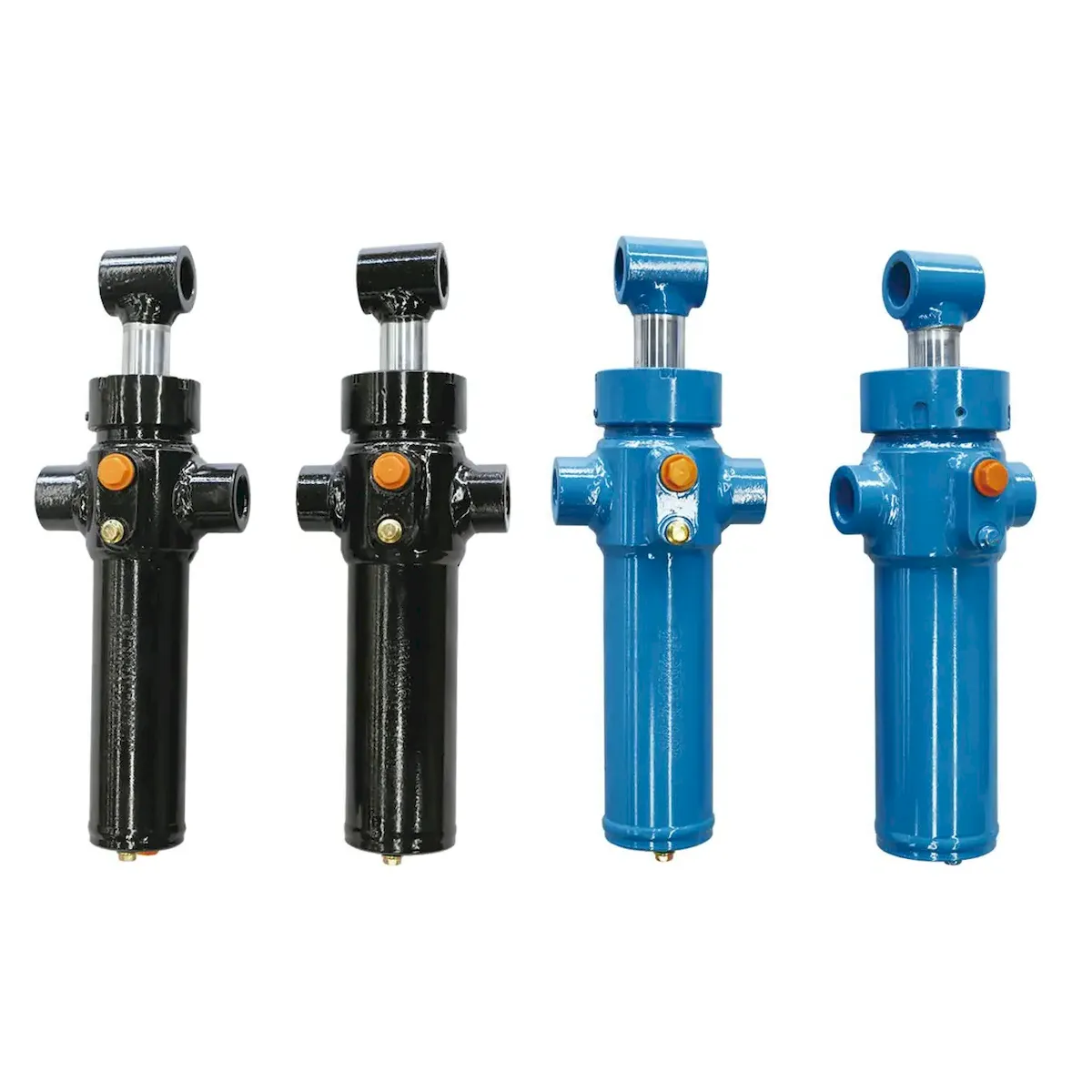
The primary lifting motion of the loader boom is powered by paired double-acting 液压升降缸 pin-mounted between the main tractor frame chassis and the lower lift arm structure. These cylinders provide the linear extension force required to raise the loaded bucket or pallet fork attachment from ground level to high-dump clearance heights exceeding 3.2 meters.
Breakout Digging Force Cycles and Peak Pressure Generation
The most demanding operational phase occurs during bucket breakout. When the operator drives the bucket cutting edge into a compacted manure pile or hardpan soil, the vehicle’s forward momentum is combined with simultaneous bucket tilt and boom lift commands.
As the bucket curls back against immovable material, hydraulic fluid trapped within the cap-end chamber of the lift cylinders experiences intense pressure spikes (P长钉 > 35.0 MPa) before the main circuit relief valve can open. This high pressure creates severe circumferential hoop stress across the cylinder barrel walls while transmitting dynamic impact shocks into the mounting pin joints.

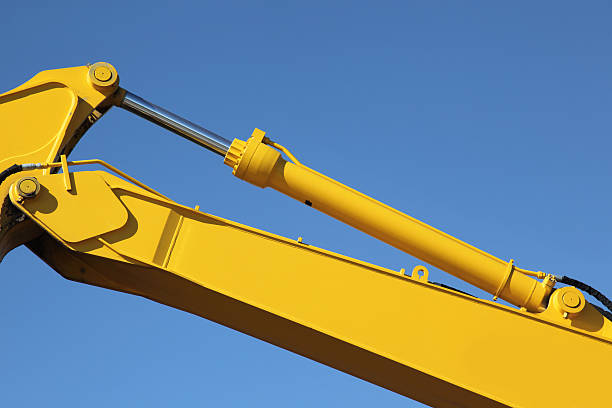
Hydraulic cylinder of front loader industrial machine
Double-Acting Piston Force Equations
Compact loader boom lift cylinders utilize a double-acting piston configuration to provide positive hydraulic force during both upward boom elevation and downward tool penetration (such as pushing post-hole diggers or scraping barn floors). The force generated during extension (Fpush) and retraction (F拉) is defined by the effective chamber areas:
其中 P液压 represents system working relief pressure (typically 21.0 to 28.0 MPa), D钻孔 is the inner barrel bore diameter (80 mm to 120 mm for compact loaders), and d杆 is the solid piston rod outer diameter (45 mm to 70 mm).
Root Cause Failure Analysis: Cylinder Barrel Longitudinal Fatigue Cracking
In agricultural loader operations, lift cylinders experience continuous pressure cycling under high breakout loads. Field service inspections reveal that Cylinder Barrel Longitudinal Fatigue Cracking (Tube Splitting) is a critical structural failure mode in undersized or low-grade lift actuators.
Standard utility cylinders manufactured with thin-walled carbon steel tubing (such as ST52 or AISI 1045) often fail prematurely when subjected to repeated breakout pressure spikes and asymmetrical side loads.

Mechanics of Circumferential Hoop Stress and Micro-Crack Initiation
When high internal hydraulic pressure spikes occur during bucket digging, the cylinder barrel acts as a cylindrical pressure vessel. The internal pressure creates a circumferential tensile stress, known as hoop stress (σ箍), which acts across the longitudinal axis of the tube wall:
其中 D里面 is the inner barrel diameter and t墙 is the tube wall thickness. If the wall thickness t墙 is insufficient, internal pressure spikes drive the peak hoop stress beyond the fatigue limit of the steel material.
If microscopic inclusions, seam lap defects, or surface scratches exist on the inner hone-finished bore surface, these microscopic flaws act as stress concentration notches. Under cyclic loading, high-tensile hoop stress causes micro-fissures to initiate at these notch roots. Over thousands of digging cycles, these fatigue cracks propagate radially outward through the wall thickness until the cylinder barrel splits open longitudinally, resulting in catastrophic loss of hydraulic power.

Asymmetrical Bucket Loading and Side Bending Stress
In farm operations, loader buckets rarely experience uniform loading. If an operator digs into a packed manure pile using only the left corner of the bucket, the asymmetrical resistance generates a twisting moment across the loader boom arm linkage.
This twisting force introduces severe side-bending stress (σ弯曲) across the extended lift cylinder piston rod and barrel assembly. On the side of the cylinder wall where internal hoop stress aligns with external bending stress, the combined tensile stress (σ全部的 = σ箍 + σ弯曲) accelerates crack propagation, causing premature barrel failure.
1. Cyclic Pressure Spikes
Digging into packed material creates pressure surges above 35.0 MPa, driving circumferential hoop stress beyond standard carbon steel fatigue thresholds.
2. Subsurface Notch Propagation
Microscopic material inclusions or bore surface defects act as stress risers, initiating micro-fissures that grow outward under dynamic fatigue cycles.
3. Longitudinal Tube Splitting
Combined hoop stress and side-bending loads force fatigue cracks through the full wall thickness, resulting in pressurized fluid blowout and complete barrel rupture.
Recommended Configuration: Heavy Thick-Wall Engineering and UT Inspection
Eliminating cylinder barrel fatigue cracking and ensuring long-term operational safety on agricultural compact loaders requires an engineered solution centered around “Heavy Thick-Wall Barrel Design” and “100% Volumetric Ultrasonic Flaw Testing (UT)”.
1. Lamé Thick-Wall Barrel Geometry
To prevent elastic tube expansion and lower internal hoop stress during severe breakout pressure spikes, cylinder barrels are designed as thick-walled pressure vessels. According to Lamé’s thick-wall equations, a cylinder is classified as thick-walled when the ratio of outer diameter to inner diameter (K = D外部 / D里面) exceeds 1.20.
For compact loader boom lift cylinders, the wall ratio is specified between 1.30 and 1.40. The radial distribution of hoop stress (σ箍) across a thick-walled tube is defined as:
Increasing the wall thickness ratio lowers peak inner-bore hoop stress by over 35%, ensuring working stresses remain well within the infinite fatigue life range of the alloy steel substrate.

2. 100% Volumetric Ultrasonic Flaw Testing Protocols (UT)
To ensure seamless alloy steel tubes contain zero subsurface defects that could initiate fatigue cracking, every raw tube extrusion undergoes 100% volumetric Ultrasonic Flaw Testing (UT per ISO 17640 / EN 12680 Level B standards):
- ▸
High-Frequency Ultrasonic Sound Wave Scanning: Piezoelectric transducers pass high-frequency sound waves through the full volume of the 42CrMo tube wall. Any internal void, slag inclusion, or longitudinal seam lap reflects sound energy back to the sensor, automatically flagging defective tubes for rejection. - ▸
100% Full-Penetration Weld Joint Inspection: Robotic full-penetration welds joining the base cap and port blocks to the thick-wall barrel undergo angle-beam ultrasonic testing to verify 100% weld fusion with zero root porosity. - ▸
1.5倍水压过压试验: Every completed cylinder assembly undergoes proof pressure testing at 150% of rated working pressure (up to 42.0 MPa) for a minimum 10-minute dwell time to verify structural integrity.
制定一个稳健的 焊接液压升降缸组件 engineered with a thick-wall barrel and 100% UT flaw inspection eliminates tube cracking risks and extends machine uptime in demanding agricultural applications.
Structural Metallurgy: 42CrMo Steel and Nickel Surface Tribology
Compact loader boom lift cylinders require high structural yield strength to absorb severe shock loads. Standard carbon structural steels (such as AISI 1045 or ST52-3) offer yield strengths around 350 to 450 MPa, making them vulnerable to fatigue failure when exposed to continuous pressure surges.
Agricultural boom lift cylinders utilize “42CrMo high-strength alloy steel” (conforming to GB/T 3077, equivalent to AISI 4140 / 42CrMo4) for both the seamless thick-wall barrel tube and the solid piston rod.
Quenching and Tempering Thermal Processing Kinetics
Raw 42CrMo seamless tubes undergo full Quenching and Tempering (Q&T). Material is heated to 850°C – 880°C for complete austenitization, polymer-quenched to achieve a martensitic grain structure, and tempered at 560°C – 620°C to produce tempered martensite.
这种热处理提高了芯材的屈服强度(σ)。0.2超过 850 MPa 和极限抗拉强度 (σb) to over 1000 MPa, with Charpy V-notch impact toughness exceeding 45 J at -20°C. High yield strength prevents permanent barrel expansion and rod bending under dynamic shock loading.
Electroless Nickel Plating (ENP) / Duplex Surface Protection
Agricultural environments expose hydraulic actuators to highly corrosive organic acids found in livestock manure, silage leachate, and liquid fertilizers. Standard chrome plating can exhibit micro-cracks that allow acidic moisture to reach the steel base, initiating under-film corrosion.
To counteract organic acid attack, the solid 42CrMo piston rod undergoes “Electroless Nickel Plating (ENP)” or a “Duplex Nickel-Chrome Coating Process” (15 μm high-phosphorus nickel underlayer + 20 μm hard chrome outer layer):
- ▸
Amorphous Nickel Underlayer (Zero Porosity): The autocatalytic electroless nickel deposit forms an amorphous, non-porous nickel-phosphorus alloy barrier over the steel rod, sealing the substrate against acidic manure slurry. - ▸
Induction Hardened Outer Shell (58-62 HRC): Medium-frequency induction hardening provides a 2.5 mm to 4.0 mm deep hardened outer case beneath the plating, preventing surface indentations when stone debris strikes the rod. - ▸
Extended Corrosion Resistance: Duplex-plated rods pass 150-hour Neutral Salt Spray (NSS) testing per ISO 9227 (Rating 10 zero-corrosion performance), ensuring long-term reliability in agricultural environments.
预防性维护、流体卫生和诊断标准操作规程

To maintain peak performance and prevent unexpected breakdowns during busy harvest seasons, farm workshop mechanics should enforce regular hydraulic inspection procedures.
ISO Cleanliness Target and Fluid Filtration Guidelines
Hydraulic oil in compact loader systems should be maintained to an ISO 4406 cleanliness code of 17/15/12 or cleaner. Airborne soil dust and fine silica particles must be prevented from entering the hydraulic reservoir using high-efficiency 10-micron return filters and desiccant breather caps.
Step-by-Step Barrel Crack & Seal Inspection Procedure
Technicians can inspect loader boom lift cylinders during routine equipment servicing using this diagnostic routine:
1. Dye Penetrant Outer Wall Inspection
Clean grease and field dirt from the outer barrel surface using solvent. Apply red dye penetrant followed by white developer spray along high-stress areas near end-cap welds and port bosses. Any red line indicates longitudinal fatigue micro-cracking requiring immediate cylinder replacement.
2. Internal Piston Seal Bypass Test
Elevate the loader boom to mid-height with a rated load, install mechanical safety support stands, and disconnect the hydraulic return line at the rod-end port. Apply cap-end pressure. If oil streams out of the open port, fluid is bypassing internal piston seals, indicating worn seal rings or barrel expansion.
Frequently Asked Questions: Compact Loader Boom Lift Cylinders
What causes cylinder barrel cracking on agricultural compact wheel loaders?
Cylinder barrel longitudinal cracking on agricultural loaders is caused by dynamic pressure surges (> 35.0 MPa) during bucket breakout operations, combined with side-bending loads from asymmetrical bucket digging. These combined forces drive circumferential hoop stress beyond the fatigue limit of standard carbon steel tubing. Microscopic inclusions or internal bore defects act as stress concentration notches, initiating micro-cracks that propagate outward until the barrel splits open.
Why is 100% Volumetric Ultrasonic Flaw Testing (UT) essential for loader lift cylinders?
Ultrasonic Flaw Testing (UT per ISO 17640) uses high-frequency sound waves to inspect the full volume of 42CrMo thick-wall tube walls and welded joints, detecting subsurface flaws such as micro-voids, slag inclusions, or seam laps before assembly. Eliminating internal material defects ensures the cylinder barrel withstands cyclic pressure spikes without initiating fatigue cracks in the field.
How does electroless nickel plating (ENP) protect hydraulic cylinder rods from manure acid corrosion?
Electroless nickel plating deposits an amorphous, non-porous nickel-phosphorus alloy coating over the 42CrMo steel substrate. Unlike micro-cracked hard chrome, the amorphous nickel underlayer provides a zero-porosity barrier that prevents organic acids from manure, silage leachate, and liquid fertilizers from penetrating to the steel base, eliminating under-film galvanic pitting corrosion.
Why is 42CrMo alloy steel superior to standard ST52 or carbon steel for loader boom cylinders?
42CrMo alloy steel delivers a yield strength exceeding 850 MPa following quenching and tempering—more than double the yield strength of standard ST52 or AISI 1045 steel. It also provides Charpy V-notch impact energy absorption of ≥ 45 Joules at -20°C. This combination of high yield strength and sub-zero impact resistance prevents structural barrel deformation and rod bending during heavy winter farm operations.
战略采购和总拥有成本
For agricultural machinery OEMs, farm equipment dealers, and livestock farm managers, unexpected cylinder failures during heavy feeding or harvest cycles cause machine downtime and high repair costs. Sourcing low-cost utility cylinders manufactured with thin-walled carbon steel or basic chrome plating often results in repeat barrel cracking, fluid leaks, and elevated total operating expenses.
设备采购团队可以评估各种技术方案。 agricultural engineering vehicle hydraulic cylinder options to verify material certifications, wall thickness specifications, and UT flaw test reports. Equipping compact loaders with heavy-duty 液压升降缸类产品 engineered with 42CrMo alloy steel, thick-wall barrels, electroless nickel plating, and 100% UT testing ensures long-term operational reliability and lower total operating costs across seasons.
Upgrade Your Compact Loader Fleet with Rupture-Proof Power
Eliminate cylinder barrel fatigue cracking, prevent organic acid corrosion, and maintain reliable boom lifting power during heavy agricultural loader operations. Explore our complete series of double-acting, 42CrMo thick-wall lift cylinders engineered for agricultural compact wheel loaders.