Earthmoving & Demolition Series · Monograph XXVII
适用于长臂挖掘机的超长臂延伸油缸
Long-reach excavators, deep foundation earthmovers, high-reach demolition machines, and river dredging excavators deploy extended boom and arm assemblies reaching working distances from 16 to 32 meters. Operating at these extreme cantilever lengths generates severe bending moments and off-center side loads across hydraulic actuators. This engineering monograph examines the structural mechanics, metallurgy, and tribological optimization of double-acting welded piston-type super-long reach extension cylinders. We analyze cantilever bending moment distribution, 42CrMo high-strength alloy steel metallurgy, the physics of localized contact stress edge spikes, rod eccentric wear mechanics, and the extended guide sleeve bearing architectures required to maintain reliability under extreme off-center loading.
Extended Guide Sleeve Bearing
Anti-Eccentric Wear Design
Engineering Specifications Matrix for Super-Long Reach Extension Cylinders
The following engineering parameters define the metallurgical, structural, sealing, and tribological criteria required for double-acting welded extension cylinders operating on long-reach excavator booms.
| 工程参数 | Long-Reach Equipment Specification Standard |
|---|---|
| 设备类别及应用 | Construction Equipment / Super Long-Reach Excavators, Dredging & Demolition Rigs |
| 子系统运动曲线 | Super-Long Arm Extension & Crowd Kinematics / Double-Acting Controlled Linear Motion |
| 液压缸名称 | Super-Long Reach Extension Cylinder (Arm / Stick Extension Actuator) |
| 动作模式和结构类型 | Double-Acting Piston Type (High-Thrust Extension / Powered High-Tension Retraction) |
| 制造业建筑业 | Robotic Full-Penetration Welded Heavy-Wall Barrel & Forged Eye Caps (ISO 15614 / AWS D1.1) |
| 材料体系冶金 | 42CrMo High-Strength Alloy Steel (GB/T 3077 / EN 10083 42CrMo4 Quenched & Tempered) |
| 表面处理和电镀 | Induction Hardened (58–62 HRC) + Precision Hard Chrome Plated (30–45 μm) |
| 环境评级等级 | Extreme Off-Center Load + Severe Boom Bending Moment + Abrasive Quarry Dust |
| 工作条件概况 | Extended Working Radii (18m to 32m) + Dynamic Side Loading + Cyclic Shock Digging |
| 主故障缓解 | Piston Rod Eccentric Wear, Chrome Flaking, Gland Edge Scoring, & Asymmetrical Seal Rupture |
| 推荐的工程要点 | Extended Guide Sleeve Assembly (L_guide / d_rod ≥ 2.0) + Bronze Wear Band Arrays |
| 额定工作压力 | 31.5 MPa to 35.0 MPa (315 – 350 Bar) High-Pressure Hydraulic Circuit Rating |
Long-Reach Boom Kinematics and Cantilever Bending Mechanics
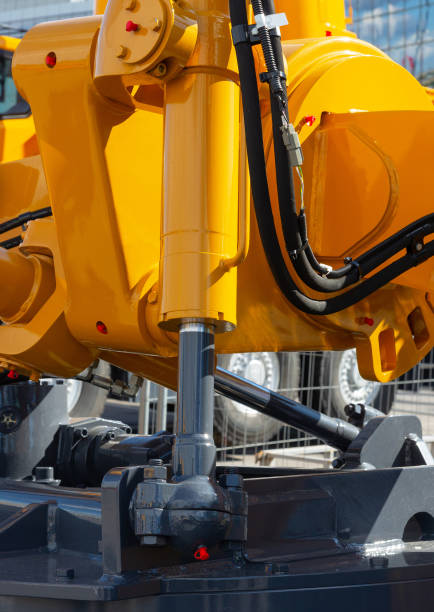
Long-reach excavators feature modified multi-piece boom and stick structures designed to operate far beyond standard digging envelopes. When digging deep foundation shafts, dredging riverbeds, or performing high-reach building demolition, the excavator bucket or hydraulic breaker acts at the tip of a long cantilever beam. The primary arm extension cylinder is pinned between the main boom structure and the extended stick, operating directly in the load path of these amplified forces.
The actuation force required to crowd or extend the long reach stick is supplied by double-acting hydraulic extension cylinders. These actuators must maintain precise position under heavy hydraulic pressures up to 35.0 MPa while accommodating extreme structural deflection across the long arm.
Cantilever Bending Moment and Off-Center Side Loads
When the excavator bucket penetrates hard ground or twists during side-sloping operations, digging resistance creates a vertical force (F_vertical) and a lateral force (F_lateral) at the bucket teeth. Due to the extended working radius (L_reach = 18 to 32 meters), these tip forces generate massive bending moments (M_bending) along the boom structure:
This bending moment deflects the long arm box-section structure laterally and vertically. Structural frame flexure transfers severe off-center side loads (F_side) directly into the extended cylinder rod end. Instead of purely axial push-pull forces, the cylinder experiences severe eccentric forces that try to bend the piston rod within the cylinder gland guide sleeve.
Double-Acting Hydraulic Force Dynamics
Double-acting extension cylinders provide powered extend thrust (F_push) during stick extension and high-tension retraction force (F_pull) during stick crowding:
Where P_hyd represents working hydraulic circuit pressure (31.5 to 35.0 MPa), D_bore is cylinder bore diameter (typically 140 mm to 220 mm), and d_rod is piston rod diameter (90 mm to 160 mm). Integrated counterbalance valves flange-mounted to the cylinder cap prevent arm dropping during sudden load changes.
Root Cause Failure Analysis: Piston Rod Eccentric Wear Mechanics
Operating long-reach excavators under heavy digging loads generates continuous side-bending forces. Field teardown analyses confirm that Piston Rod Eccentric Wear (rod side-frictional wear / gland scoring) is the primary failure mode in standard extension cylinders deployed on long-reach machines.
When off-center side loads act against an extended piston rod, the rod tilts within the gland housing. In conventional cylinders equipped with short guide bushings, this tilting action concentrates huge contact forces onto narrow localized contact bands.
1. Localized Contact Stress Edge Spikes
In a short guide sleeve, side force (F_side) creates an opposing force reaction couple across the front edge of the guide bushing and the rear piston bearing. The contact pressure (σ_contact) across the guide interface is non-uniform, spiking dramatically at the outer lip edge:
When σ_contact(edge) exceeds the yield limit of the guide bushing material or the fatigue threshold of the hard chrome layer, the lubricating oil film breaks down completely, leading to direct metal-to-metal contact.
2. Chrome Layer Flaking, Scuffing, and Seal Rupture
The combination of extreme edge contact stress and sliding motion during extension strokes initiates severe galling and scuffing along one side of the chrome-plated piston rod:
1. Asymmetrical Chrome Wear
Localized high contact pressure wears away the hard chrome layer on one side of the rod, exposing the underlying steel to scoring and rapid oxidation.
2. Asymmetrical Seal Distortion
Rod tilting compresses the primary U-cup seal unevenly. The heavily compressed side undergoes permanent compression set, while the opposite side loses contact pre-load.
3. High-Pressure Oil Leakage
Hydraulic fluid streams past the uncompressed seal lip, causing rapid pressure loss, uncommanded arm drift, and complete operational failure.
Structural Metallurgy: 42CrMo Alloy Steel & Chrome Tribology
Super-long reach excavators demand high material strength to resist permanent rod bending and barrel expansion under severe cantilever loads. Standard carbon structural steels (like Q235B or AISI 1020) lack sufficient yield strength, leading to plastic rod curvature when off-center side loads occur.
Long-reach arm extension cylinders deploy “42CrMo high-strength alloy steel” (conforming to GB/T 3077, equivalent to EN 10083 42CrMo4 / AISI 4140) for both the solid piston rod and heavy-wall welded barrel tubing.
Quenching and Tempering Thermal Processing
42CrMo raw stock undergoes complete Quenching and Tempering (Q&T) thermal treatment. The steel is austenitized at 850°C – 880°C, oil-quenched to form fine martensite, and tempered at 560°C – 600°C. This process raises material yield strength (σ_s) to ≥ 850 MPa and ultimate tensile strength (σ_b) to ≥ 1000 MPa, with Charpy V-notch impact energy absorption exceeding 45 J at -20°C.
High yield strength guarantees that the solid piston rod deforms elastically under severe side loads without taking a permanent bend set, maintaining exact dimensional straightness over millions of operating cycles.
| 钢材等级 | Yield Strength (σ_s) | Tensile Strength (σ_b) | 夏比冲击能量(-20°C) |
|---|---|---|---|
| Q235B(标准碳钢) | ≥ 235 兆帕 | 370 – 500 兆帕 | ≤ 20 J @ +20°C |
| Q345D(低合金钢) | ≥ 345 兆帕 | 470 – 630 兆帕 | ≥ 34 J @ -20°C |
| 42CrMo Alloy Steel (Q&T Heat Treated) | ≥ 850 兆帕 | ≥ 1000 兆帕 | ≥ 45 J @ -20°C |
Induction Hardened Hard Chrome Plating
The solid 42CrMo piston rod undergoes medium-frequency induction hardening to form a 3.0 mm to 4.5 mm deep hardened case (58 to 62 HRC). Following precision centerless grinding (Ra ≤ 0.15 μm), the rod is electroplated with a 30 μm to 45 μm thick hard chromium layer featuring a micro-cracked structure (400 to 600 cracks/cm). Micro-cracks retain hydraulic oil films, reducing friction against gland guide bushings and resisting quarry dust abrasion.
Recommended Configuration: Extended Guide Sleeve & High-Load Bearings
Completely eliminating piston rod eccentric wear, chrome flaking, and gland seal rupture under heavy long-reach bending moments requires an engineered “Anti-Eccentric Wear Protection Package” based on two core mechanical upgrades: “Extended Guide Sleeve Architecture” and “High-Load Wear Band Arrays”.
1. Extended Guide Sleeve Length Ratio (L_guide / d_rod ≥ 2.0 to 2.5)
The front gland housing guide length (L_guide) is extended relative to the piston rod diameter (d_rod), establishing a guide ratio of L_guide / d_rod ≥ 2.0 to 2.5 (compared to 1.0 to 1.2 in standard utility cylinders).
Increasing the guide bearing contact length spreads side forces over a much larger surface area (A_contact = π × d_rod × L_guide). This expanded bearing footprint reduces peak localized contact stress (σ_contact) by over 60%, preventing edge stress spikes and keeping contact pressure well below the yield threshold of the bearing material.
2. Centrifugally Cast Bronze-PTFE Wear Band Arrays
To absorb heavy side loads without scoring the piston rod chrome layer, the internal bore of the extended guide sleeve incorporates dual or triple centrifugally cast bronze-filled PTFE wear bands (or heavy-duty CuAl10Fe3 aluminum-bronze guide bushings):
- ▸
High Compressive Load Support (> 120 MPa): Bronze-filled PTFE wear bands sustain intense side-loads without plastic cold-flow deformation, maintaining proper radial clearance around the dynamic seal pack. - ▸
Debris Embeddability: Soft bronze-PTFE matrices absorb stray dust grains that pass wiper seals, embedding particles safely below the sliding surface to protect hard chrome plating from scratch marks. - ▸
Symmetrical Seal Compression: By restricting rod tilting within tight tolerances (≤ 0.05 mm radial play), the extended guide sleeve keeps primary U-cup seals uniformly compressed, eliminating asymmetrical seal wear.
Specifying a heavy-duty welded hydraulic extension cylinder engineered with 42CrMo alloy steel, extended guide sleeves, and bronze wear band arrays ensures long-term operational reliability on super-long reach excavators.
预防性维护、流体卫生和诊断标准操作规程
ISO Cleanliness Target and Daily Visual Inspection
Hydraulic fluid in long-reach excavator circuits must be maintained to an ISO 4406 cleanliness code of 16/14/11 or cleaner. Technicians should inspect extended piston rods daily for single-sided chrome dulling, scuff lines, or uneven oil films, which signal early eccentric wear.
Step-by-Step Diagnostic SOP for Rod Alignment Runout
Field mechanics can evaluate rod straightness and guide bushing wear during scheduled service intervals using this procedure:
1. Dial Indicator Straightness Measurement
Fully extend the arm cylinder under no-load conditions and support the long reach stick safely. Mount a magnetic dial indicator to the outer barrel face with its tip resting on the chrome rod surface. Rotate or sweep along the full stroke length. Total Indicated Runout (TIR) exceeding 0.20 mm per meter indicates permanent rod bending requiring replacement.
2. Gland Bearing Clearance Verification
With the cylinder partially retracted, measure the radial clearance gap between the rod outer surface and the front gland wiper housing using feeler gauges around four orthogonal positions. Asymmetrical clearance variation exceeding 0.35 mm indicates severe wear on one side of the internal guide sleeve, requiring immediate guide sleeve replacement.
Frequently Asked Questions: Long-Reach Extension Cylinders
What causes piston rod eccentric wear on long-reach excavator extension cylinders?
Piston rod eccentric wear (rod side-frictional wear) is caused by massive off-center side loads and bending moments transmitted from the extended arm structure. In cylinders with short guide bushings, side loads concentrate extreme contact stress onto the outer edge of the bushing. This edge stress breaks down hydraulic oil films, causing direct metal-to-metal rubbing, scuffing on one side of the chrome rod, and uneven gland seal distortion.
How does an extended guide sleeve (L_guide / d_rod ≥ 2.0) eliminate eccentric wear?
An extended guide sleeve increases the internal bearing contact length to at least twice the rod diameter. This expanded bearing area distributes off-center side loads over a much wider surface area, reducing peak edge contact stress by over 60%. Lower contact stress prevents oil film breakdown, eliminates rod scuffing, and keeps dynamic gland seals uniformly compressed.
Why is 42CrMo alloy steel necessary for super-long reach excavator arm cylinders?
42CrMo high-strength alloy steel delivers a yield strength exceeding 850 MPa and ultimate tensile strength of ≥ 1000 MPa following quenching and tempering. This high yield strength prevents the long piston rod from suffering permanent plastic bending under heavy digging moments at full reach, ensuring structural straightness over millions of operating cycles.
What are the signs of gland guide sleeve wear on long-reach hydraulic cylinders?
Key indications of guide sleeve wear include single-sided chrome dulling or longitudinal scuff lines on the extended rod, uneven hydraulic oil weeping from the gland wiper, metallic particles in return line oil filters, and asymmetrical radial clearance measured between the rod and gland wiper housing using feeler gauges.
战略采购和总拥有成本
For specialty excavation contractors, demolition equipment managers, and long-reach boom manufacturers, extension cylinder failure results in costly machine downtime and expensive job site delays. Sourcing low-cost commodity cylinders built with standard carbon steel or short guide bushings leads to rapid eccentric rod wear, fluid leaks, and high total cost of ownership (TCO).
Procurement engineering teams can evaluate technical options across long-reach excavator hydraulic cylinder options to verify material heat treatment, extended guide sleeve dimensions, and bronze wear band specifications. Equipping super-long reach excavators with heavy-duty welded hydraulic lift cylinders engineered with 42CrMo alloy steel, extended guide sleeves, and induction-hardened rods guarantees long-term operational reliability across demanding earthmoving projects.
Upgrade Your Long-Reach Equipment with Anti-Bending Power
Eliminate piston rod eccentric wear, resist severe cantilever bending moments, and ensure zero-leak operation at extended working radii. Explore our complete series of double-acting, 42CrMo long-reach extension cylinders engineered for long-boom excavators.