Heavy Transport Engineering Series · Volume III
Advanced Engineering of
Telescopic Lift Cylinders
in Commercial Dump Trucks
The commercial hauling and mining sectors demand actuators capable of extreme force generation within severely restricted spatial envelopes. This definitive engineering guide dissects the multi-stage kinematics, complex internal porting, and metallurgical resilience required for single and double-acting telescopic cylinders to safely eject payloads exceeding 100 metric tons.
Hoop Stress Analysis
Double-Acting Porting
01. The Spatial Paradox and Multi-Stage Kinematics
In heavy mechanical design, the fundamental geometry of a dump truck presents an absolute spatial paradox. To completely evacuate cohesive materials like wet clay or hot asphalt, a dump bed must be elevated to an angle of 45 to 50 degrees. This required arc translates to an immense linear stroke length. However, when the bed is lowered into its stowed, transport position, the available vertical clearance between the chassis frame rails and the bottom of the dump body is exceptionally tight. A standard single-rod hydraulic lift cylinders capable of achieving that massive stroke would protrude several feet below the truck’s axles, physically dragging on the highway.
The engineering solution is the telescopic cylinder. By utilizing a series of nested tubular stages (commonly 3, 4, or 5 sleeves), the actuator can collapse into a highly compact closed length—often less than 25% of its fully extended stroke. As pressurized hydraulic fluid enters the base, the kinematics of extension unfold in a highly predictable, mathematically defined sequence.
The Physics of Sequential Stage Extension
According to Pascal’s Law, force ($F$) equals pressure ($P$) multiplied by the effective area ($A$). Because all internal stages are exposed to the exact same fluid pressure simultaneously, the stage with the largest internal surface area will unequivocally extend first. This is a brilliant natural synergy with the mechanics of a dump truck.
When the dump bed is flat, the entire weight of the payload rests against gravity with minimal mechanical advantage. The largest outer stage provides the massive “breakaway” force necessary to initiate the lift. As the bed raises, the center of gravity shifts rearward toward the hinge pin, meaning less force is required to continue lifting. Consequently, when the first stage hits its mechanical stop ring and the second (smaller) stage takes over, the available lifting force drops, but the extension velocity dramatically increases (assuming constant pump flow). This results in a highly efficient, accelerating dump cycle.
02. Architectural Divergence: Single-Acting vs. Double-Acting Systems
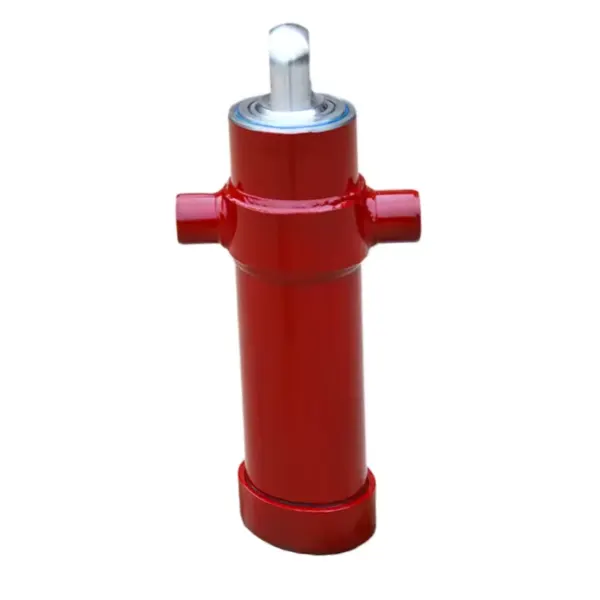
While all telescopic cylinders share the nested-sleeve design, their internal fluid routing architectures diverge sharply based on the application’s retraction requirements. Understanding when to specify single-acting versus double-acting variants is the cornerstone of heavy transport engineering.
⬇️ Single-Acting (Gravity Retraction)
The vast majority of standard tipper trucks utilize single-acting telescopic cylinders. They feature only one hydraulic port at the base. Fluid pressure is used solely to extend the stages. To retract, the directional control valve connects the cylinder base back to the reservoir, and the immense physical weight of the empty steel dump bed, combined with gravity, forces the hydraulic oil out of the cylinder. This design is highly economical, requires minimal plumbing, and features simpler internal sealing configurations (typically V-packing sets at the top of each sleeve).
🔄 Double-Acting (Hydraulic Retraction)
In specific applications—such as horizontal push-out ejector trailers, refuse compactors, or articulated dump trucks operating in freezing environments where cold, viscous oil impedes gravity descent—double-acting cylinders are mandatory. These actuators use hydraulic pressure for both extension and retraction. They require an incredibly complex internal architecture, featuring cross-drilled porting through the pistons and internal transfer tubes to route pressurized fluid to the annular (rod-side) area of every moving stage simultaneously, physically pulling the cylinder closed.
03. Kinematic Geometry: Front-End Trunnion vs. Underbody Hoist
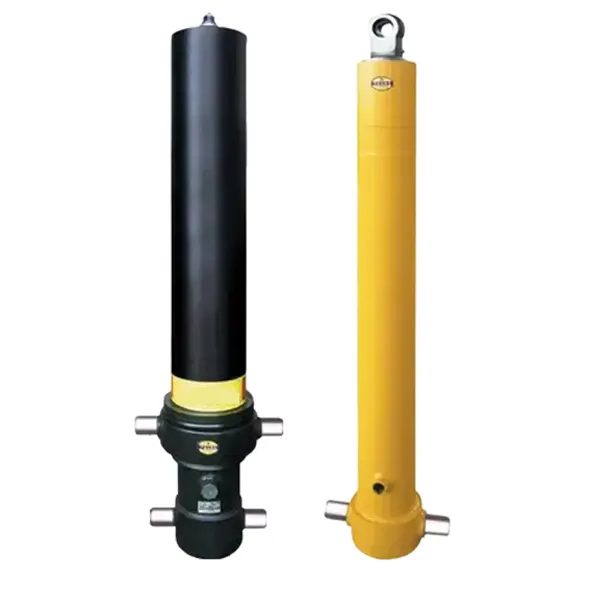
The physical placement of the telescopic cylinder relative to the dump body hinge drastically alters the mechanical stress and hydraulic pressure requirements of the system. Engineers must choose between Underbody Hoist configurations and Front-End (Doghouse) configurations based on payload metrics and chassis length.
- 1
Front-End (Doghouse) Geometry
Mounting the cylinder at the extreme front of the dump body provides the absolute maximum mechanical lever arm from the rear hinge pivot. Because Torque = Force × Distance, maximizing the distance means the required lifting force is minimized. This allows the system to lift 100+ ton payloads at lower operating pressures, significantly extending pump and seal life. These cylinders utilize outer-cover spherical trunnion mounts, allowing the entire cylinder body to pivot safely as the bed angle changes, neutralizing destructive side-loads.
- 2
Underbody Hoist Geometry
Used primarily on smaller municipal trucks and landscaping vehicles, the underbody hoist places the cylinder underneath the bed, pushing up near the middle of the frame. This drastically shortens the lever arm, requiring significantly higher internal hydraulic pressure to initiate the lift compared to a front-end setup for the exact same payload. However, it preserves bed space (no doghouse required) and protects the cylinder from falling debris during loading.
04. Advanced Metallurgy and Buckling Resistance
The structural weakness of any telescopic cylinder is the risk of buckling. When fully extended, a 5-stage cylinder essentially becomes a highly loaded, slender column. If the dump truck is sitting on uneven terrain, the shifting payload exerts massive lateral forces (side-loading) on the extended stages. If the structural integrity of the steel sleeves or the internal overlap is insufficient, the cylinder will buckle catastrophically, bringing the dump bed crashing down.
🔬 High-Yield Alloys and Stage Overlap
To counter buckling and hoop stress, premium manufacturers construct the stages from 27SiMn seamless steel tubing. This manganese-silicon alloy boasts a yield strength significantly higher than standard ST52-3 steel. Furthermore, the external surfaces of the moving stages undergo medium-frequency induction hardening before hard-chrome plating. This creates an armor-like shell that resists denting from falling rocks—a dent that would otherwise destroy the internal seals as the stage retracts.
Critically, the mechanical design must incorporate substantial “stage overlap.” When a stage is fully extended, a calculated percentage of its length (typically 1.5x the internal bore diameter) must remain safely nested inside the preceding larger stage. This overlap acts as a rigid moment-bearing guide, transferring lateral forces safely through the thickest parts of the steel tubes and preventing the cylinder from snapping at the joints.
Sealing a telescopic cylinder involves multiple dynamic pressure zones. Single-acting stages typically utilize heavy-duty chevron packing (V-packing) sets. Unlike standard O-rings, V-packing is pressure-responsive; as hydraulic pressure spikes, the V-shaped lips flare outward, tightening the seal against the moving stage. This design is exceptionally robust against the shock loads inherent when a sticky payload suddenly releases from a raised dump bed.
05. Expert Diagnostics and Troubleshooting
Because dump trucks operate in highly abrasive environments (quarries, construction sites, landfills), their hydraulic systems are uniquely vulnerable. Maintenance technicians must be adept at diagnosing anomalies before they escalate into structural failures.
Diagnostic: Stage Binding or Sticking
If the cylinder retracts jerkily, or if a smaller stage refuses to drop until significant weight is added, it is suffering from stage binding. This is almost exclusively caused by a bent stage tube—the result of dumping on severely unlevel ground, which subjected the extended cylinder to extreme lateral side-loading beyond its buckling limits. The cylinder must be removed, and the bent stage must be re-tubed by a certified hydraulic repair facility. Operating a bound cylinder will rapidly shred the internal seals and gall the metal surfaces.
Diagnostic: “Weeping” at Stage Joints
A microscopic film of oil on extended stages is normal (it lubricates the wiper seals). However, if hydraulic fluid actively drips from the joints during the lift cycle, the V-packing or U-cup seals have failed. This is typically caused by severe fluid contamination. Silicate dust bypasses a damaged external wiper seal, mixing with the oil to form a lapping paste that grinds away the elastomeric pressure seals. Ensure fluid cleanliness meets ISO 4406 standards (18/16/13) to prevent premature seal erosion.
06. Fleet Procurement and Total Cost of Ownership
For commercial hauling fleets, downtime is the ultimate enemy. When a telescopic cylinder suffers a catastrophic failure (such as a bent stage or deeply scored barrel), rebuilding it in-house is often cost-prohibitive in terms of labor and lost revenue compared to replacing the entire unit.
Procurement managers must strategically source replacement units that match the exact OEM trunnion mounts, pin-eye diameters, and collapsed-length dimensions. Exploring comprehensive specialized catalogs for a telescopic hydraulic cylinder allows fleet directors to procure aftermarket units forged from superior 27SiMn steel with upgraded polyurethane seal kits. This strategic upgrading reduces the total cost of ownership (TCO) by extending the operational interval before the next required rebuild, keeping the trucks on the road and generating revenue.
Equip Your Fleet with Unmatched Lifting Power
Prevent catastrophic buckling and maximize payload efficiency. Explore our catalog of precision-engineered multi-stage telescopic cylinders built for the punishing demands of commercial hauling and heavy mining.