Agricultural Trailer Logistics Series · Monograph XIX
Tailgate Lift Cylinders for Agricultural Trailers
Agricultural trailers and farm haulage vehicles rely on hydraulic tailgate liftgate platforms for efficient loading and unloading of palletized farm produce, seed tote bags, fertilizer drums, and heavy livestock equipment. Operating on soft, unlevel field terrain under severe cantilever payload torque, these hydraulic actuators face intense bending moments and impact loads. This technical engineering guide analyzes the structural mechanics, material science, and anti-bending design of double-acting welded multi-stage tailgate lift cylinders. We examine cantilever lifting kinematics, 42CrMo alloy steel heat treatment kinetics, the root causes of stage sleeve bending and rod buckling, oversized rod engineering, electroless nickel surface protection, and impact-resistant internal cushioning architectures.
Oversized Rod Engineering
Electroless Nickel Plating
Engineering Specifications Matrix for Farm Trailer Tailgate Cylinders
The following engineering parameters establish the structural, metallurgical, sealing, and operational standards required for double-acting multi-stage telescopic tailgate lift cylinders deployed on agricultural trailers.
| Engineering Parameter | Agricultural Trailer Tailgate Specification Standard |
|---|---|
| Equipment Category & Application | Agricultural Trailer Vehicles / Farm Haulage & Field Transport Trailers |
| Subsystem Motion Profile | Hydraulic Tailgate Liftgate System / Multi-Stage Linear Elevation & Tilt Circuit |
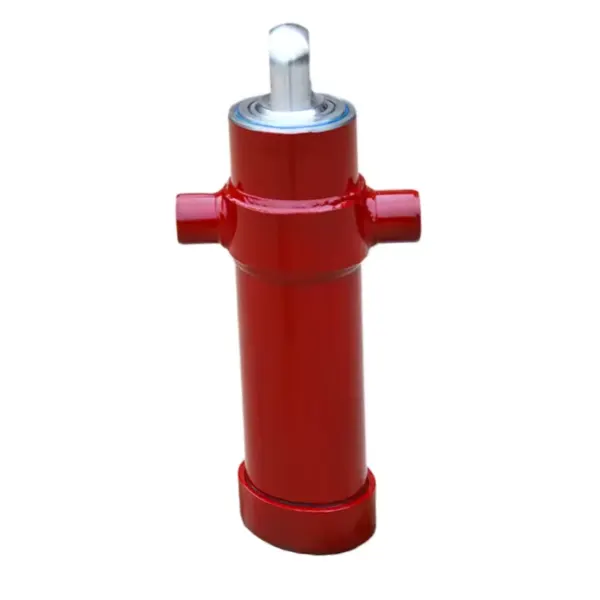
| Hydraulic Cylinder Name | Tailgate Lift Cylinder (Double-Acting Multi-Stage Telescopic Type) |
| Action Mode & Structural Type | Double-Acting Multi-Stage Telescopic (Powered Push Elevation & Powered Pull Lowering) |
| Manufacturing Construction | Full-Penetration Robotic Welded Base & Mounting Clevis Architecture (AWS D1.1) |
| Material System Metallurgy | 42CrMo High-Strength Alloy Steel (Quenched & Tempered Seamless Tubes) |
| Surface Treatment & Finish | Electroless Nickel Plating (ENP) / Duplex Nickel-Chrome Layer (25–35 μm) |
| Environmental Rating Class | Heavy Payload + Severe Uneven Ground + Organic Fertilizer Acids + Field Mud Slurry |
| Working Conditions Profile | Lifting Heavy Cargo Pallets (1.5 to 3.5 Tons) + Dynamic Off-Center Cantilever Shock |
| Primary Failure Mitigated | Piston Rod / Telescopic Stage Sleeve Permanent Bending & Buckling Failure |
| Recommended Engineering Keypoints | Oversized Stage Tube Cross-Sections + Impact-Resistant Cushions + Extended Guiding |
| Nominal Pressure Rating | 18.0 MPa to 25.0 MPa (180 – 250 Bar) Continuous Working Relief Pressure |
Agricultural Trailer Tailgate Kinematics and Cantilever Lifting Mechanics
Agricultural trailers and farm logistics vehicles perform critical transport roles during harvest and field maintenance operations. Moving seed totes, bulk chemical containers, palletized bagged fertilizer, and heavy machinery parts requires versatile rear-loading capabilities. To facilitate loading without requiring elevated farm loading docks, trailers are equipped with hydraulic tailgate liftgate platforms.
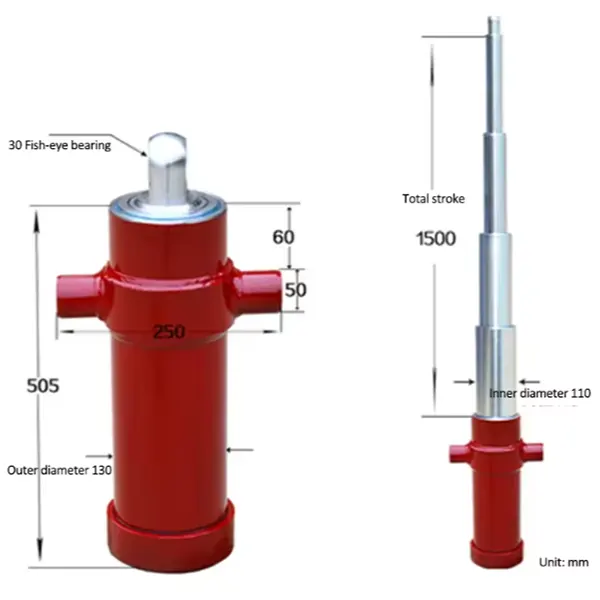
The vertical elevation and tilting motions of the tailgate platform are powered by specialized hydraulic lift cylinders. Pin-mounted underneath the trailer rear chassis frame, these double-acting main lift cylinders extend to elevate heavy platform loads from ground level up to bed deck height (1,100 mm to 1,500 mm).
Double-Acting Multi-Stage Telescopic Advantage in Compact Envelopes
Farm trailer chassis feature limited rear ground clearance due to high-clearance off-road tires, axle suspensions, and rear underrun protection bars. Standard single-stage cylinders cannot deliver the required total stroke length without extending below axle clearance limits during road travel.
Double-acting multi-stage telescopic cylinders solve this geometric constraint by nesting multiple tubular stage sleeves within a single main outer barrel. Double-acting operation provides positive hydraulic pressure during both lifting and lowering cycles, ensuring controlled platform descent even when handling sticky, unyielding cargo in cold weather when viscous oil drag resists gravity lowering.
Cantilever Moment Torque and Hydraulic Thrust Equations
When a pallet jack or heavy seed container drives onto the tailgate platform, the payload weight acts as a cantilever load at a moment arm distance Lcargo from the main lift linkage pivot pins. The hydraulic thrust force Flift required from the lift cylinders is defined as:
Where Wplatform and Wcargo are platform and cargo weights, Lpivot is the mechanical linkage pivot distance, and α is the effective cylinder inclination angle. Because sin(α) is small when the platform rests on the ground, the initial breakaway lifting force demanded from the cap chamber is exceptionally high, requiring operating hydraulic pressures up to 25.0 MPa.
Root Cause Failure Analysis: Piston Rod and Stage Sleeve Bending
Agricultural trailer tailgate lift cylinders operate under severe dynamic stress combinations. Unlike highway delivery trucks that unload on flat concrete loading docks, farm trailers frequently load and unload on soft farmyard mud, sloped fields, or rutted gravel tracks. Under these conditions, the dominant structural failure mode is Piston Rod and Stage Sleeve Permanent Bending (Buckling).
Standard utility hydraulic cylinders manufactured with thin-walled carbon steel stage tubes or standard-diameter rods fail rapidly when subjected to asymmetrical cargo loading on uneven field ground.
1. Mechanics of Dynamic Side-Bending on Soft Unlevel Ground
When an agricultural trailer operates on unlevel field terrain, the wheels on one side sink into soft soil, causing the entire trailer frame to tilt. If a 2,000 kg pallet of fertilizer is driven onto one side of the tailgate platform, the payload weight vector creates an intense off-center twisting moment Mbending across the fully extended cylinder assemblies:
Where eeccentricity is the off-center distance of the load, Lextended is the extended stroke length, and θslope is the ground tilt angle. The extended multi-stage cylinder sleeves act as a slender stepped cantilever column. If the area moment of inertia (I) of the stage tubes is insufficient, the combined axial compressive stress and lateral bending stress exceed the yield strength (σy) of the steel, resulting in permanent curved rod deformation.
2. Barrel Ovalization and Gland Seal Destruction
Stage sleeve bending directly causes internal gland seal destruction. As a high bending moment acts across a stage junction, it crushes the internal guide wear bands on one side, forcing the circular cross-section of the stage sleeve to distort into an ellipse (ovalization).
This oval distortion widens the clearance gap behind the gland seal on the opposite side. Under high hydraulic pressure (Phyd ≥ 20.0 MPa), the soft polyurethane seal lip extrudes into this expanded gap, tearing apart within hundreds of stroke cycles and causing severe hydraulic oil leaks across the trailer rear frame.
Dynamic Slope Bending
Off-center pallet loading on unlevel field ground generates extreme lateral side loads, bending slender telescopic stage sleeves beyond their elastic recovery limits.
Stage Sleeve Ovalization
Severe bending moments distort tubular stage sleeves into an oval shape, crushing guide wear bands and widening clearance gaps behind gland seals.
Seal Extrusion Blowout
Widened clearance gaps allow high-pressure oil to force soft seal heels into the extrusion space, tearing the seal lip and causing pressurized fluid leakage.
Structural Metallurgy: The Superiority of 42CrMo Alloy Steel
Preventing piston rod bending and stage sleeve buckling under severe off-road unloading conditions requires high yield strength and fatigue resistance. Standard structural carbon steels (such as Q235B or AISI 1045) and basic DOM tubing (such as ST52-3) offer yield strengths around 235 to 355 MPa, making them vulnerable to permanent bending when an agricultural trailer tips on soft field ground.
High-performance farm trailer tailgate cylinders deploy “42CrMo high-strength alloy steel” (conforming to GB/T 3077, equivalent to AISI 4140 / 42CrMo4 under EN 10083-3 standards) for all tubular stage sleeves, base housings, and clevis mounts.
Quenching and Tempering Thermal Processing Kinetics
Seamless 42CrMo stage tubes undergo full Quenching and Tempering (Q&T). Tubes are heated to 850°C – 880°C for complete austenitization, polymer-quenched to convert the microstructure into fine martensite, and tempered at 560°C – 620°C to produce tempered martensite.
This heat treatment raises the core yield strength (σ0.2) to over 850 MPa and ultimate tensile strength (σb) to over 1000 MPa, with Charpy V-notch impact toughness exceeding 45 J at -20°C. High yield strength enables 42CrMo stage sleeves to flex elastically under extreme side loads during sloped unloading and return to perfect straightness without permanent set.
Mechanical Property Comparison
| Steel Material Grade | Yield Strength (σ0.2) | Tensile Strength (σb) | Charpy Impact Energy (-20°C) |
|---|---|---|---|
| AISI 1045 (Medium Carbon) | ≥ 355 MPa | ≥ 600 MPa | ≤ 20 J @ +20°C |
| ST52-3 / E355 (DOM Tubing) | ≥ 355 MPa | ≥ 520 MPa | ≥ 27 J @ -20°C |
| 42CrMo Alloy Steel (Q&T) | ≥ 850 MPa | ≥ 1000 MPa | ≥ 45 J @ -20°C |
Electroless Nickel Plating (ENP) Corrosion Protection
Agricultural trailers operate in harsh environments containing organic livestock acids, liquid fertilizers, and field mud. Standard hard chrome plating can exhibit micro-fissures that allow acidic moisture to reach the steel base, initiating under-film corrosion.
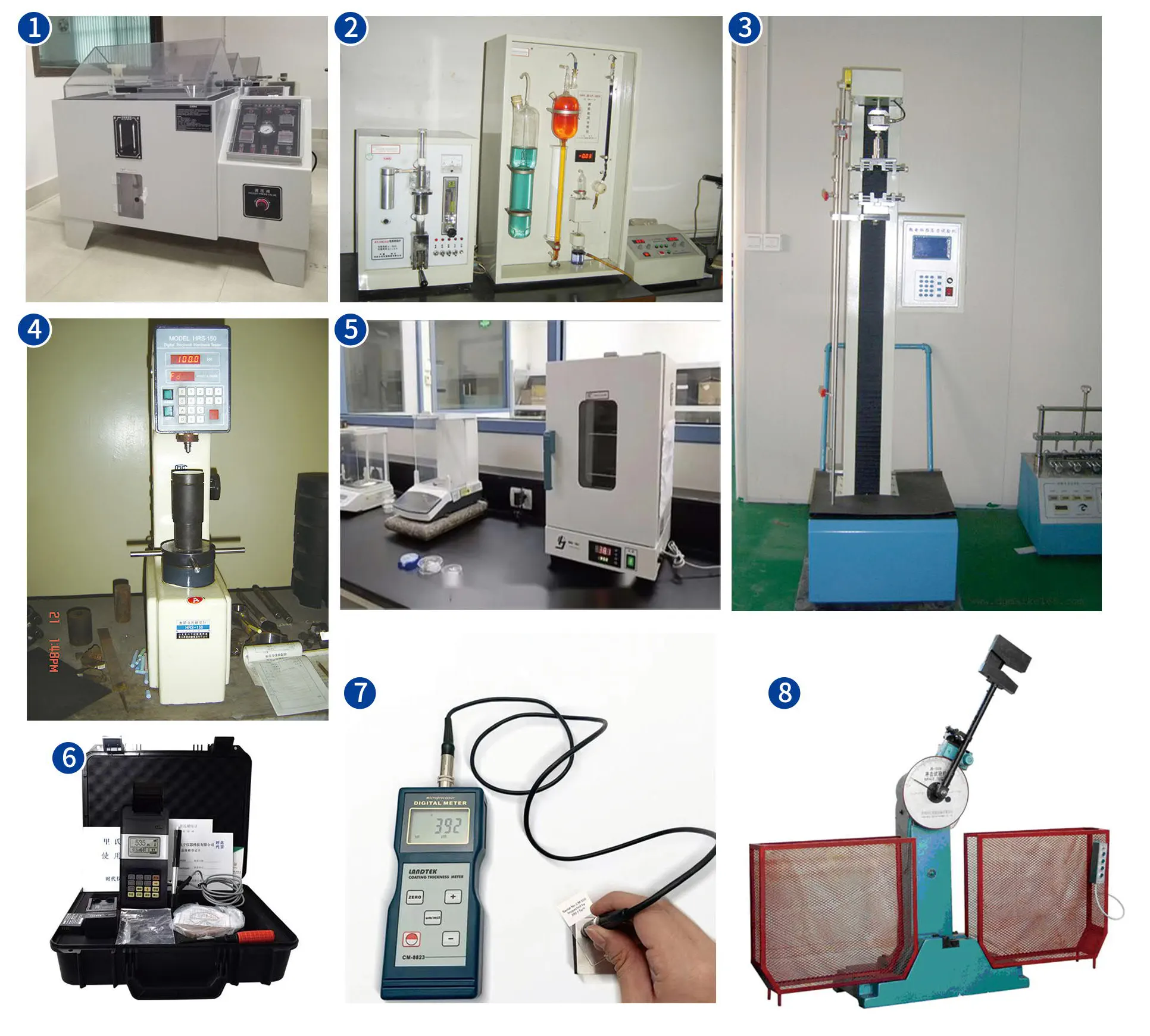
To counteract organic acid attack, the outer surface of every 42CrMo stage sleeve undergoes “Electroless Nickel Plating (ENP)” or a “Duplex Nickel-Chrome Coating Process” (15 μm high-phosphorus nickel underlayer + 20 μm hard chrome outer layer). The non-porous nickel underlayer seals the steel substrate against acidic manure slurry, while the hard chrome outer layer provides a surface hardness of 58 to 62 HRC, passing 150-hour neutral salt spray corrosion testing (ISO 9227 Rating 10 performance).
Recommended Configuration: Oversized Stage Engineering and Impact-Resistant Structure
Eliminating stage bending and seal extrusion on agricultural trailer tailgate lift systems requires an engineered “Heavy-Duty Multi-Stage Configuration Package” featuring three structural upgrades: “Oversized Stage Tube Engineering”, “Impact-Resistant Internal Cushioning”, and “Extended Guide Overlap”.
1. Oversized Stage Tube Engineering (Increasing Moment of Inertia)
Resistance to bending is directly proportional to the area moment of inertia (I) of the stage sleeve cross-section:
By increasing stage sleeve wall thickness twall and specifying oversized outer tube diameters, the moment of inertia I is increased by over 45%. This structural reinforcement lowers bending deflection under off-center pallet loading, preventing permanent sleeve deformation on soft ground.
2. Impact-Resistant Cushioning and Anti-Extrusion Sealing
Every stage gland utilizes an engineered multi-component seal array designed to absorb dynamic pressure shocks:
- ▸
Fabric-Reinforced Multi-Lip Vee-Packing Stack: Rubber-impregnated cotton duck fabric lips conform under hydraulic pressure, maintaining a tight seal even if stage sleeves experience minor radial flexure. - ▸
PEEK Anti-Extrusion Back-Up Rings: Installed behind primary seals to bridge clearance gaps under pressure spikes up to 25.0 MPa, preventing soft seal heel extrusion nibbling. - ▸
Heavy Dual-Lip Metal-Cased Mud Scraper: A polyurethane scraper ring housed in a steel shell scrapes away dried field mud, straw fibers, and manure slurry before stage sleeves retract into parent tubes.
3. Enhanced Guide Overlap & Wear Band System
To distribute lateral bending moments caused by uneven loading on field slopes, the internal guide overlap length between adjacent stage sleeves at full extension is extended to Loverlap ≥ 1.8 × Dstage. Centrifugally cast bronze-filled PTFE guide bands guide stage movement, absorbing side-bending loads without scoring the plated stage surfaces.
Specifying a robust multi-stage telescopic hydraulic lift cylinder engineered with 42CrMo steel, oversized stage tubes, and impact seals eliminates stage bending and oil leaks in agricultural trailer applications.
Preventive Maintenance, Fluid Hygiene, and Diagnostic SOP
To maintain fluid power reliability during busy harvest seasons, farm trailer maintenance staff should enforce regular hydraulic inspection procedures.
ISO Cleanliness Target and Air Bleeding Guidelines
Hydraulic oil in agricultural trailer systems should be maintained to an ISO 4406 cleanliness code of 18/16/13 or cleaner. Contaminated oil accelerates wear on stage seals and tractor control valve spools. Trapped air inside multi-stage telescopic cylinders must be bled periodically via top vent plugs; compressed air causes erratic stage movement and platform bouncing during loading.
Step-by-Step Diagnostic SOP for Stage Bending & Leakage
Technicians can inspect farm trailer tailgate lift cylinders using this diagnostic routine:
1. Stage Straightness & Alignment Check
Fully extend the telescopic cylinder with an empty platform and secure safety support stands. Place a precision steel straightedge along the length of each extended 42CrMo stage sleeve. Any gap exceeding 1.0 mm over a 1,000 mm span indicates permanent stage bending requiring sleeve replacement.
2. Inter-Stage Gland Seal Leakage Test
Wipe all stage gland faces clean of field dirt. Pressurize the cylinder to full extension under working hydraulic pressure. If oil streams out of a specific stage gland face, the internal Vee-packing stack or PEEK back-up ring is damaged and requires immediate replacement.
Frequently Asked Questions: Agricultural Trailer Tailgate Cylinders
What causes piston rod and stage sleeve bending on farm trailer tailgate lift cylinders?
Piston rod and stage sleeve bending on agricultural trailer tailgate cylinders is caused by dynamic cantilever side loads generated when loading heavy cargo pallets on unlevel field ground. As trailer wheels sink into soft farmyard mud, off-center loading introduces severe twisting moments across fully extended stage sleeves. If the stage tubes are made from standard low-yield carbon steel, the combined bending stress exceeds the yield point, resulting in permanent rod distortion.
How does 42CrMo alloy steel prevent telescopic stage sleeve buckling during farm loading?
42CrMo alloy steel delivers a core yield strength exceeding 850 MPa following quenching and tempering—more than double the yield strength of standard Q235 or ST52 steel tubing. This high yield strength enables extended multi-stage cylinder sleeves to flex elastically under cantilever side loads caused by off-center pallet loading on tailgate platforms and return to perfect straightness without permanent bending or binding.
Why is electroless nickel plating (ENP) superior to standard chrome plating in agricultural environments?
Electroless nickel plating deposits an amorphous, non-porous nickel-phosphorus alloy layer over the 42CrMo steel substrate. Unlike micro-cracked hard chrome, the amorphous nickel underlayer provides a zero-porosity barrier that prevents organic acids from manure, fertilizer runoff, and acidic soil moisture from penetrating to the steel base, eliminating under-film galvanic pitting corrosion.
How do oversized stage tubes and PEEK back-up rings prevent oil leaks under high pressure spikes?
Oversized stage tubes increase the area moment of inertia (I = π(D^4 – d^4)/64), reducing bending deflection and preventing barrel ovalization. Meanwhile, PEEK (Polyetheretherketone) back-up rings feature a high tensile modulus (> 3,500 MPa) that bridges gland clearance gaps under pressure spikes up to 25.0 MPa, preventing soft elastomer seal heels from extruding and eliminating oil leaks.
Strategic Procurement and Total Cost of Ownership
For farm trailer manufacturers, agricultural logistics operators, and equipment dealers, unexpected tailgate cylinder failures during time-sensitive harvest seasons cause delivery delays and high repair expenses. Sourcing low-cost replacement cylinders built with thin-walled carbon steel or basic single-lip seals often leads to repeated stage bending, oil leaks, and elevated total operating costs over time.
Equipment procurement teams can evaluate technical options across mobile agricultural trailer hydraulic cylinder options to verify material certifications, tube wall thickness specifications, and pressure test reports. Equipping agricultural trailers with heavy-duty telescopic hydraulic lift cylinders for trailers and trucks engineered with 42CrMo alloy steel, oversized stage tubes, and electroless nickel plating ensures long-term operational reliability and lower total operating costs across farm haulage routes.
Upgrade Your Farm Trailer Logistics with Bending-Proof Power
Eliminate piston rod bending, prevent inter-stage seal extrusion leaks on unlevel ground, and maintain reliable tailgate platform elevation. Explore our complete series of double-acting, 42CrMo multi-stage telescopic lift cylinders engineered for agricultural trailer vehicles.