Product Description
Product Description
Seamless Steel Honed Tube is made of JIS STKM13C/ DIN ST52/ ASTM A106/ SAE1571 and welded pipe: DIN ST52.3 are also offered. Seamless Steel Hydraulic Cylinder Honed Tube withstands higher pressure than welded tube without splits. But, roundness of welded honed barrels is superior to seamless pipe. After honing, carbon steel cylinder honed tube of mechanical structure use has precision diameter, smooth surface, and excellent performance of oil storage. This kind of Hydraulic Cylinder Tube and Pneumatic Cylinder Tube work smoothly without pauses and has longer working life in cylinders. Applies to hydraulic cylinders tube, pneumatic cylinders tube, forklift, crane, excavator, punching machine, and other kinds of labor-saving automatic mechanical engineering.
Advantage of Product
1)Professional & skilled, reliable.
2)One-stop total solution
3)ready stock goods with fast delivery
4)Customizable: Non-standard sizes are also available
5)Small quantity is acceptable
6)Cash back: Refund or replacement for any product faulty
| Product Name | Hydraulic Cylinder Honed Tube | |||
|
Standard |
DIN2391, EN10305, ASTM A519, GB/T 3639-200 |
|||
|
Material |
Q355B Q355D C20,ST52,E355 SAE1026.CK STKM 13C |
|||
|
Heat treatment |
BK+S |
|||
|
Specification |
Outer diameter(mm) : 40-480mm |
|||
|
I.D Tolerance |
H8-H9 |
|||
|
Length |
Fixed Length, Random Length(3–9m)or as requests of customers |
|||
|
Straightness |
0.5-1/1000 |
|||
|
ID roughness |
RA 0.1-0.8micron(max) |
|||
|
Payment term |
FOB, CFR, CIF ,EXW, FCA and so on |
|||
|
MOQ |
3 tons |
|||
|
Technology |
Honed & SRB(SKIVED AND ROLLER BURNISHED ) |
|||
|
Application: |
hydraulic cylinder, swivel crane, injection machine and so on |
|||
|
Conservation |
anti rust oiled inside and outside surface, plastic caps in both ends |
|||
|
Package |
bundle with steel strip and knitting strip, or wooden case |
|||
| After-sales Service: | Support |
|---|---|
| Warranty: | Support |
| Type: | Seamless |
| Technique: | Hot Rolled |
| Material: | Carbon Steel |
| Surface Treatment: | Black |
| Samples: |
US$ 20/Piece
1 Piece(Min.Order) | |
|---|
| Customization: |
Available
|
|
|---|
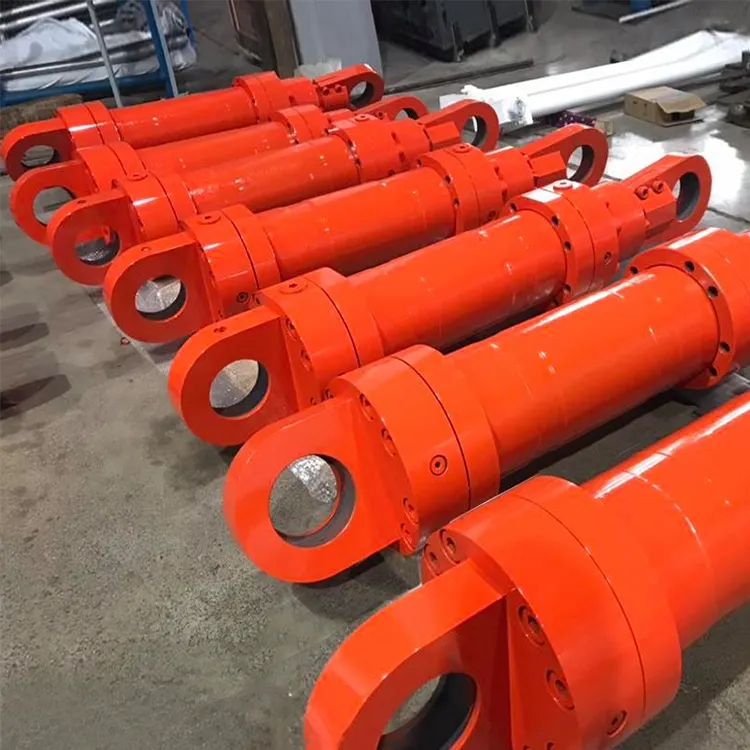
How does a forklift hydraulic cylinder handle variations in cylinder size?
A forklift hydraulic cylinder is designed to handle variations in cylinder size and accommodate different lifting capacities. Here’s an explanation of how it achieves this:
The hydraulic cylinder’s ability to handle variations in cylinder size is primarily dependent on its design and the following factors:
1. Piston Diameter:
The piston diameter of the hydraulic cylinder determines the lifting force it can generate. Forklift hydraulic cylinders are designed with different piston diameters to accommodate various load capacities. Larger piston diameters provide higher lifting capacities, while smaller diameters are suitable for lighter loads. The cylinder is designed and manufactured to match the required lifting capacity based on the forklift’s specifications.
2. Cylinder Construction:
The hydraulic cylinder is constructed to withstand the forces exerted during lifting operations. The materials used in its construction, such as high-strength steel, are selected based on the anticipated load capacities. The cylinder’s structural integrity ensures that it can handle the stress and pressure exerted during lifting, regardless of the cylinder size.
3. Hydraulic System Pressure:
The hydraulic system pressure plays a crucial role in determining the lifting capacity of the cylinder. By increasing or decreasing the pressure of the hydraulic fluid, the lifting force generated by the cylinder can be adjusted. The forklift’s hydraulic system is designed to provide sufficient pressure to match the lifting requirements of different cylinder sizes.
4. Control Valves and Flow:
The forklift’s hydraulic system incorporates control valves that regulate the flow of hydraulic fluid to the cylinder. These valves allow the operator to control the speed and force of the cylinder’s extension and retraction. By adjusting the flow rate, the lifting capacity can be tailored to suit the specific cylinder size and the load being lifted.
5. Sealing Mechanisms:
The hydraulic cylinder incorporates seals to prevent fluid leakage and maintain pressure. These seals, designed to accommodate different cylinder sizes, ensure a proper seal between the piston and cylinder barrel. They are selected based on the specific requirements of the cylinder size to maintain optimal performance and prevent leakage.
In summary, a forklift hydraulic cylinder handles variations in cylinder size by incorporating design elements such as piston diameter, appropriate construction materials, hydraulic system pressure, control valves, and sealing mechanisms. These factors work together to ensure that the cylinder can generate the required lifting force and withstand the forces exerted during lifting operations, regardless of the cylinder size.
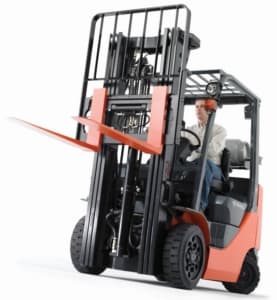
How does a forklift hydraulic cylinder contribute to load rotation?
A forklift hydraulic cylinder plays a significant role in facilitating load rotation. The hydraulic cylinder enables the forklift to manipulate and reposition loads by providing controlled rotational movement. Here’s an explanation of how the hydraulic cylinder contributes to load rotation:
The forklift hydraulic cylinder contributes to load rotation in the following ways:
1. Tilt Function:
Hydraulic cylinders are responsible for the tilt function of the forklift’s mast or carriage. The hydraulic cylinder controls the tilting mechanism, allowing the forks or attachments to tilt forward or backward. By adjusting the tilt angle, the hydraulic cylinder enables the forklift to change the orientation of the load and achieve load rotation.
2. Controlled Movement:
The hydraulic cylinder provides controlled movement during load rotation. It allows the operator to adjust the speed and direction of the tilt function, ensuring smooth and precise rotation of the load. The operator can manipulate the hydraulic controls to achieve the desired rotation angle and maintain stability throughout the process.
3. Load Centering:
Hydraulic cylinders contribute to load rotation by assisting in load centering. The hydraulic system can be equipped with attachments such as rotators or clamps that are actuated by hydraulic cylinders. These attachments help secure the load and ensure it remains centered during rotation, preventing imbalances or accidents.
4. Load Manipulation:
The hydraulic cylinder allows for load manipulation during rotation. By controlling the tilt function, the hydraulic cylinder enables the forklift to precisely position the load, making it easier to place or retrieve items from specific locations. Load rotation facilitated by the hydraulic cylinder enhances the forklift’s versatility and efficiency in various material handling tasks.
5. Operator Control:
Forklift hydraulic cylinders are operated by the forklift operator using hydraulic controls. The operator can adjust the tilt angle and speed of the hydraulic cylinder to achieve the desired load rotation. The hydraulic system provides the necessary responsiveness and control, allowing the operator to safely and accurately manipulate the load.
In summary, a forklift hydraulic cylinder enables load rotation through its tilt function, controlled movement, load centering capabilities, load manipulation, and operator control. The hydraulic cylinder’s ability to provide controlled rotation enhances the forklift’s versatility and efficiency in handling different types of loads and materials.
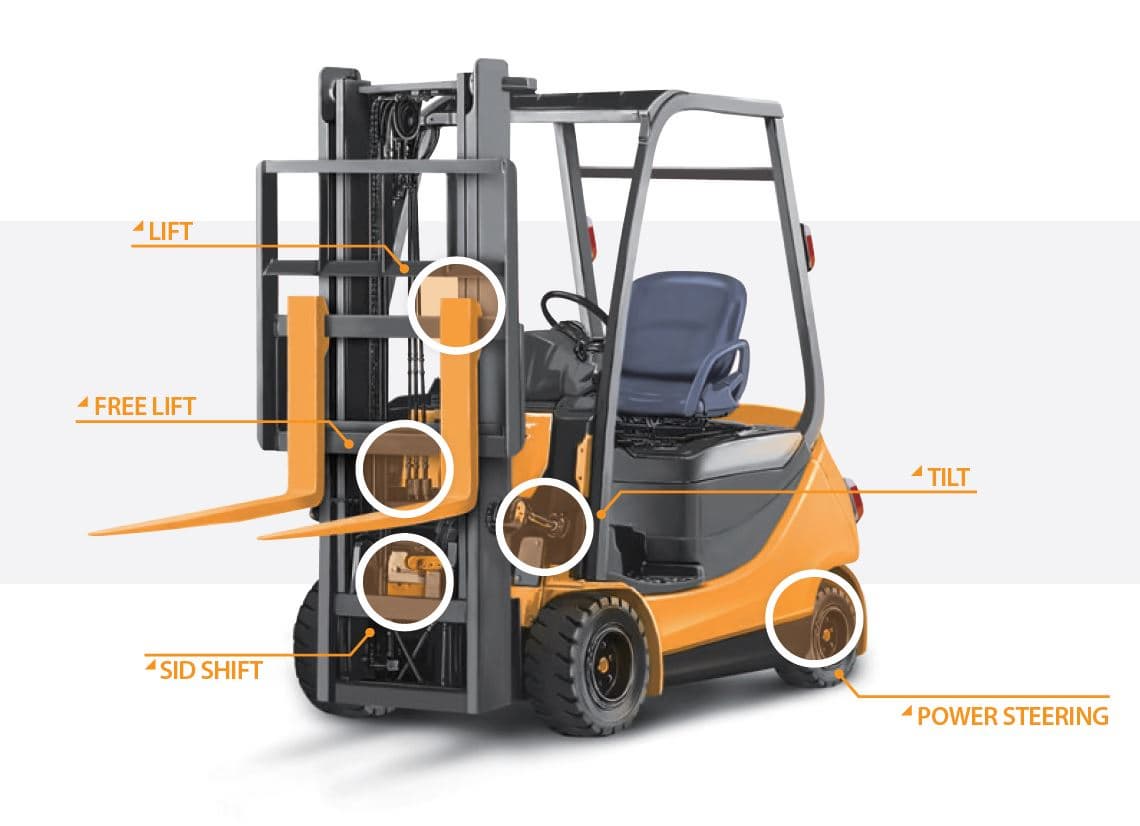
What is a forklift hydraulic cylinder and how does it work?
A forklift hydraulic cylinder is a crucial component in the hydraulic system of a forklift. It is responsible for generating the force required to lift and lower the load. Here’s a detailed explanation of its function and operation:
Function:
A forklift hydraulic cylinder is designed to convert hydraulic pressure into linear force. It consists of a cylindrical barrel, a piston, piston rod, seals, and ports for hydraulic fluid entry and exit. The cylinder is usually mounted vertically within the forklift’s mast assembly.
Operation:
The hydraulic cylinder operates based on the principle of Pascal’s law, which states that when pressure is applied to a fluid in an enclosed system, the pressure is transmitted equally in all directions.
When the operator activates the forklift’s hydraulic control, hydraulic fluid (usually oil) is pressurized and directed into the cylinder through the inlet port. The pressurized fluid enters one side of the cylinder, pushing the piston and piston rod upwards.
As the piston rod extends, it applies force to the load-bearing structure of the forklift, such as the mast or the lifting mechanism. This force enables the forklift to lift heavy loads to the desired height.
Conversely, when the operator releases the hydraulic control, the hydraulic fluid is allowed to exit the cylinder through the outlet port. The fluid flows back into the hydraulic reservoir, and the weight of the load or a counterbalance system helps lower the piston and piston rod.
The hydraulic cylinder’s movement is controlled by the operator through the forklift’s hydraulic control system, which regulates the flow of hydraulic fluid into and out of the cylinder. By adjusting the flow rate and direction, the operator can control the speed and direction of the cylinder’s extension and retraction.
The seals within the hydraulic cylinder prevent fluid leakage and ensure efficient operation. They help maintain the pressure inside the cylinder, allowing the hydraulic system to generate the necessary force consistently.
In summary, a forklift hydraulic cylinder is a hydraulic device that converts hydraulic pressure into linear force. It operates based on Pascal’s law, using pressurized hydraulic fluid to extend and retract the piston rod, enabling the forklift to lift and lower heavy loads.


editor by CX 2023-10-27