Advanced Mechanical Engineering Series
Hydraulic Lift Cylinders for
Heavy Machinery
Discover how fluid dynamics transforms mechanical heavy equipment across aerial platforms, extreme-duty agricultural tractors, massive mining dump trucks, and harsh offshore environments, maximizing operational efficiency and equipment longevity.
Kinematics
Tribology & Sealing
01. The Core Physics and Manufacturing of Lift Cylinders
The operational foundation of all гидравлические подъемные цилиндры is governed by Pascal’s Principle, which dictates that pressure exerted anywhere in a confined incompressible fluid is transmitted equally in all directions throughout the fluid. In heavy machinery, this seemingly simple physical law is harnessed to multiply force to an extraordinary degree. When a hydraulic variable displacement pump delivers fluid at high pressures—often ranging from 200 bar (2900 psi) in standard industrial applications to over 350 bar (5000+ psi) in heavy mobile equipment—into the base of a cylinder, it acts upon the full surface area of the piston. The resulting thrust is the mathematical product of the pressure and the area, enabling relatively compact cylinders to lift payloads weighing tens or hundreds of metric tons with exceptional precision.

However, generating raw mechanical force is only one dimension of the engineering challenge. The modern manufacturing processes behind these cylinders must proactively address severe mechanical stress, side-loading, thermal expansion, and abrasive environmental contamination. Modern manufacturing leverages high-yield strength steel alloys, specifically 27SiMn (a Chinese standard manganese-silicon steel offering superior tensile strength) or European standard ST52-3, for the cylinder barrels. The internal surfaces of these thick-walled seamless steel tubes undergo rigorous Skiving and Roller Burnishing (SRB) or deep-hole honing. This subtractive and forming manufacturing hybrid process achieves a mirror-like surface finish (typically Ra 0.2 to 0.4 µm). This extreme smoothness minimizes friction and dramatically extends the lifespan of the internal polyurethane (PU) and Polytetrafluoroethylene (PTFE) composite seals.
Simultaneously, the piston rods—which are constantly exposed to the harsh external environment—are subjected to rigorous metallurgical enhancements. First, the rods undergo medium-frequency induction hardening. This heat treatment increases the surface hardness to HRC 55-60, allowing the rod to resist impact damage, such as falling rocks in a mining environment or accidental collisions in a warehouse. Following induction hardening, the rods are treated with a micro-cracked hard chrome plating (usually applied at a thickness of 20 to 30 microns). This micro-cracked structure holds microscopic amounts of hydraulic oil, providing constant lubrication to the rod seals while offering exceptional corrosion resistance against ambient moisture and chemical exposure.
Understanding the fluid dynamics within these systems is also paramount. Hydraulic fluid acts not only as the power transmission medium but also as a vital lubricant and heat-transfer agent. As fluid is forced through narrow valve orifices under high pressure, kinetic energy is converted into thermal energy. Lift cylinders feature engineered clearance tolerances that specifically accommodate the thermal expansion of the steel components without causing seal extrusion, fluid bypass, or catastrophic metal-to-metal galling under sustained operational loads.
🔬 Volumetric Efficiency
Refers to the ratio of actual fluid flow to theoretical fluid flow. High-performance lift cylinders utilize advanced zero-leakage elastomeric seal geometries to prevent internal fluid bypass across the piston, maintaining over 98% volumetric efficiency even under peak holding loads over extended durations.
📊 Buckling Resistance
Calculated using Euler’s Column Formula, buckling resistance dictates the absolute maximum safe stroke of a cylinder. Mechanical designers must utilize oversized rod diameters and precise internal stop-tubes to prevent structural bowing and catastrophic failure when fully extended under massive axial loads.
🌡️ Thermal Stability
Hydraulic fluid constantly experiences viscosity changes due to friction-induced heat during throttling. Advanced cylinders utilize high-temperature Viton (FKM) seals that resist thermal degradation, preventing leaks when localized fluid temperatures spike during intensive, continuous cycling.
02. Precision and Safety in Aerial Work Platforms (AWP)

Aerial Work Platforms (AWPs), encompassing both complex scissor lifts and telescopic/articulating boom lifts, represent one of the most safety-critical applications for fluid power dynamics. The aerial work vehicle cylinders act as the central nervous system of platform elevation. Unlike dump trucks where rapid material dumping is the primary priority, AWP cylinders must prioritize microscopic precision, absolute rigid stability, and guaranteed zero-drop failure modes to protect human life and expensive surrounding infrastructure.
Consider the physics: When an articulated boom lift extends an operator 150 feet into the air, even a millimeter of internal seal bypass in the main boom lift cylinder translates to significant, terrifying platform sway and descent at the apex due to the massive leverage multiplier. To combat this inherent danger, mechanical engineers deploy specialized Pilot-Operated (PO) check valves and Counterbalance valves (CBVs). Crucially, these valves are not merely bolted onto the system with vulnerable external hoses; they are flanged directly into the cylinder’s steel head or integrated directly as cartridge valves within the cylinder barrel itself. This direct integration guarantees that if a hydraulic feed hose catastrophically ruptures due to abrasion or over-pressurization, the fluid remains hydraulically locked inside the cylinder chamber, and the platform holds its exact position indefinitely.
Key Design Specifications for AWP Cylinders:
- ✔️
Stick-Slip (Stiction) Prevention: Utilizing advanced PTFE (Teflon) composite seals infused with bronze or carbon fiber to eliminate the “stick-slip” phenomenon. This ensures buttery-smooth ascent and descent kinematics regardless of extreme load variations or low-velocity operational commands. - ✔️
Regenerative Circuitry Compatibility: Intelligently designed internal porting that works seamlessly with regenerative hydraulic systems. These circuits route exhaust fluid from the rod end directly back into the cap end, increasing cylinder extension speed without requiring massive, energy-draining pump flow. - ✔️
Emergency Lowering Mechanics: The mandatory integration of manual mechanical bleed valves, typically painted red for high visibility. These allow ground personnel to safely and slowly lower the platform back to earth in the event of a total engine failure or electrical system blackout. - ✔️
Hydraulic Vibration Dampening (Cushioning): Implementing tapered spear cushioning technology at the extreme ends of the stroke (both cap and rod ends). This restricts fluid flow in the final millimeters of travel, decelerating the massive metal piston gradually and preventing harsh mechanical impacts that could jolt the operator and induce metal fatigue.
03. Agricultural Dominance: Tractors and No-Tillage Machinery
The heavy agricultural sector subjects hydraulic systems to the most brutal and unforgiving environmental conditions imaginable: relentless UV exposure, extreme diurnal temperature swings, aggressive fertilizer-induced chemical corrosion, and endless bombardment by highly abrasive silicate dust and wet mud. In this relentless arena, the lift cylinder is not merely a component; it is the fundamental muscle that drives global food production, requiring robust seals that act as absolute barriers against environmental ingress.

Tractor rear hitches—specifically the globally standardized Three-Point Hitch system—rely on heavy-duty double-acting cylinders to lift plows, heavy seeders, and deep cultivators. Modern tier-4 agricultural tractors feature advanced Electro-Hydraulic Hitch Control (EHC). The lift cylinders in these systems are often fitted with integrated Linear Variable Differential Transformers (LVDTs) or sophisticated magnetostrictive absolute position sensors nested inside the hollowed piston rod. These internal sensors are impervious to external mud and feed continuous, sub-millimeter positional data back to the tractor’s central ECU. When combined with draft pins (force sensing load cells) in the lower linkage arms, the ECU automatically modulates the cylinder extension height to maintain a constant pulling load on the diesel engine, adjusting instantly and autonomously as soil density and terrain topography changes.
Innovations in Precision No-Tillage Farming
Modern conservation agriculture has heavily driven the rise of no-tillage (zero-till) farming, an eco-friendly methodology which preserves vital soil moisture and prevents topsoil erosion by leaving the previous season’s crop residue completely undisturbed on the field. However, physically cutting through this tough, fibrous residue to plant seeds requires highly specialized, dynamic downforce mechanics. Modern high-speed planters utilize Main and Auxiliary Lifting Spring Cylinders. These unique hybrid actuators combine the raw force of hydraulic fluid power with the rapid response of heavy-duty mechanical coil springs or pneumatic air-bags.
- 1
Active Downforce Modulation: As the massive planter moves at speeds up to 10 mph across uneven, undulating terrain, the hydraulic cylinder applies active proportional pressure to compress the mechanical spring. This ensures the row unit’s steel disc openers slice into the soil at a precise, mathematically uniform depth, guaranteeing optimal seed germination spacing. - 2
Kinetic Shock Absorption: If a specific row unit strikes a massive subterranean rock or hardened stump, the mechanical spring instantly compresses, absorbing the violent kinetic shock. This prevents catastrophic structural failure to the planter frame, while the hydraulic relief valve simultaneously bleeds off pressure spikes to protect the pump. - 3
Automated Headland Management: At the physical end of the field (the headlands), the tractor’s GPS-guided hydraulic remote automatically reverses fluid flow, commanding the lift cylinder to overcome the spring tension and rapidly retract, lifting the entire multi-ton row unit completely out of the earth for a swift turning maneuver.
04. Heavy-Duty Hauling: Telescopic Cylinders in Dump Trucks and Mining
When engineering lifting solutions for commercial dump trucks, transfer trailers, and massive articulated mining haulers, extreme space constraints collide with the uncompromising need for massive stroke lengths. A standard single-rod cylinder capable of lifting a dump bed to a necessary 45-to-50-degree angle would physically protrude several feet beyond the truck chassis when fully retracted, rendering the vehicle completely undrivable. The brilliant mechanical engineering solution to this spatial paradox is the telescopic dump truck cylinders.
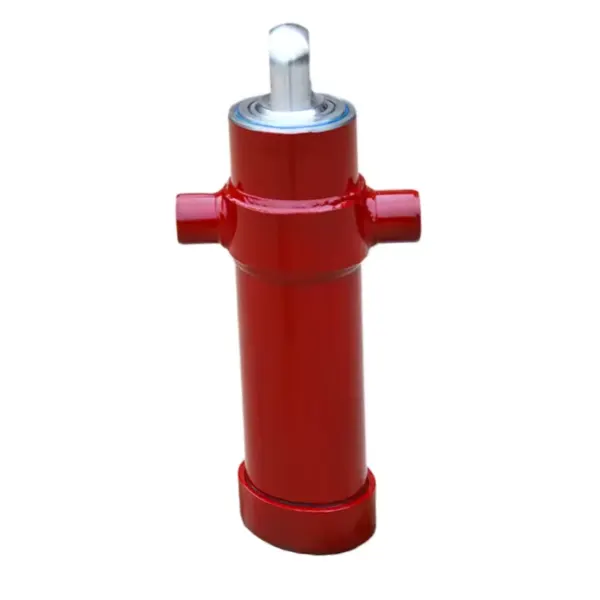
Telescopic cylinders consist of a highly complex series of nested tubular stages (often ranging from 3 to 6 stages) of decreasing diameter. As pressurized fluid enters the base port, the stage with the largest internal effective area logically extends first. This generates the absolute highest initial breakaway force—which is mathematically necessary to lift the fully loaded, horizontally resting dump body against the maximum lever arm of gravity. Once the first stage hits its internal mechanical stop ring, the fluid pressure acts on the next largest stage, which begins to extend, and so forth. Because the effective piston area progressively decreases with each subsequent stage, the lifting force drops, but the extension speed rapidly increases (assuming constant pump flow). This elegantly matches the physical kinematics of a dump bed, which naturally requires less force to push upwards as the center of gravity of the payload shifts backwards past the rear hinge pivot.
The Physics of Front Top Lifting Geometry
In heavy open-pit mining trucks handling 100+ to 400-ton payloads, Front Top Lifting Cylinders are the undisputed standard. Mounted vertically at the extreme front of the dump body (often referred to as the doghouse), this specific geometric mounting provides the longest possible mechanical lever arm relative to the rear hinge. This drastically reduces the necessary hydraulic pressure required to initiate the lift compared to inferior underbody hoist designs. These cylinders often feature enormous bore sizes (e.g., 150-180mm minimum) and utilize robust spherical trunnion mounts or cross-tube pin-eyes to pivot smoothly, entirely eliminating catastrophic side-load stress on the internal cylinder seals as the bed angle violently changes during material ejection.
While most standard commercial dump trucks utilize Single-Acting telescopic cylinders (using gravity and the immense weight of the empty steel bed to force the hydraulic fluid back into the reservoir for retraction), specialized applications demand more control. Vehicles such as ejector trailers, municipal refuse collection trucks, and horizontal push-outs require Double-Acting telescopic cylinders. These highly complex actuators use hydraulic pressure for both forceful extension and rapid retraction, featuring intricate internal porting systems that seamlessly route high-pressure fluid to the rod-side annulus of each moving stage.
05. Conquering the Extremes: Industrial, Marine, and Offshore Applications
Beyond standard land-based mobile machinery, hydraulic lift cylinders are the undeniable backbone of advanced marine engineering, subsea exploration, and offshore oil/gas operations. In these unforgiving environments, the primary enemy is not just lifting immense physical load, but surviving severe galvanic corrosion, saltwater degradation, and extreme hydrostatic pressures. Equipment such as heavy-lift shipboard cranes, offshore platform jack-up rigs, wave-energy converters, and deep-sea ROV manipulators require highly specialized fluid power actuators.
When specifying equipment for these sectors, standard chrome-plated rods are demonstrably insufficient, often failing due to pitting within months. Instead, marine engineers must rigorously source specialized offshore hydraulic cylinders. These specialized units abandon traditional electroplated hard chrome in favor of ultra-high-end advanced surface treatments such as HVOF (High-Velocity Oxygen Fuel) thermal spraying, or even solid stainless steel alloys like Duplex (2205) or Super Duplex (2507). HVOF applies a dense, virtually pore-free coating of Tungsten Carbide or Nickel-Chromium superalloys to the piston rod at supersonic speeds. This provides absolute impermeability to aggressive saltwater chlorides and unmatched resistance to mechanical scratching from barnacles, ice, and marine debris.
Furthermore, offshore cylinders utilize distinctly unique sealing architectures. Marine environments necessitate heavy-duty double-wiper seal arrangements specifically designed to scrape away highly abrasive dried salt crystals and marine bio-fouling before they can enter the cylinder head and destroy the primary pressure seals. The hydraulic fluids used offshore are frequently Environmentally Acceptable Lubricants (EALs)—biodegradable synthetic esters or polyglycols. These fluids demand absolute chemical compatibility with specialized Viton (FKM) or Polyurethane elastomers to prevent chemical seal swelling, degradation, and catastrophic, ecologically disastrous fluid leakage into the ocean ecosystem.
06. Expert Maintenance, Diagnostics, and Troubleshooting
Maximizing the Total Cost of Ownership (TCO) and operational uptime of heavy machinery dictates a highly proactive, rather than reactive, approach to hydraulic cylinder maintenance. A catastrophic cylinder failure in a high-production mining dump truck or a time-sensitive agricultural combine harvester can halt operations, costing tens of thousands of dollars in lost production per hour. The following protocols represent the gold standard for diagnostic maintenance in fluid power systems.
Visual and Operational Diagnostics
- 🔧
Rod Scoring and Metal Galling: Deep longitudinal scratches or milky discoloration on the chrome rod indicate that environmental contaminants (sand, rock dust, welding slag) have bypassed the external wiper seal, or that the internal bronze or composite wear bands (guiderings) have completely disintegrated. This causes disastrous metal-to-metal contact between the heavy steel piston and the polished barrel. Immediate cylinder removal for re-tubing or re-chroming is mandatory to prevent full system contamination. - 🔧
Cylinder Drift (Internal Fluid Leakage): If a suspended heavy load (such as a tractor implement, an excavator boom, or an elevated scissor lift) slowly sinks over time while the directional control valve is perfectly centered in neutral, internal leakage across the piston is occurring. This is expertly diagnosed by performing a bypass test: extending the cylinder fully, shutting off the engine safely, removing the return line to the tank, and applying pump pressure to the extend port. Any fluid weeping from the return port indicates failed or extruded piston seals. - 🔧
Spongy Operation, Aeration & Cavitation: If the cylinder movement is jerky, erratic, or feels “spongy,” atmospheric air has entered the closed system. More severely, if a loud, rhythmic knocking or gravel-like crackling sound is heard during operation, hydraulic cavitation is occurring. Cavitation happens when fluid cannot flow fast enough to fill the cylinder cavity (often due to clogged suction filters), creating microscopic vacuum bubbles that implode with enough violent force to tear micro-chunks of metal from the cylinder barrel walls.
Seal Replacement and Fluid Hygiene Protocol
🛢️ Fluid Contamination Control
Hydraulic fluid contamination is responsible for over 75% of all lift cylinder failures. Implementing an ISO 4406 cleanliness standard monitoring program is crucial. For sensitive proportional valves and high-pressure lift cylinders, a strict ISO cleanliness code of 18/16/13 or better must be maintained through the use of high-efficiency glass-fiber return filters and off-line kidney-loop filtration systems.
🛡️ Seal Geometry and Material Upgrades
When rebuilding a failed cylinder, engineers should not default to standard OEM O-rings. Instead, they should analyze the failure mode and upgrade to advanced geometries like loaded U-cups or Z-seals for rod sealing, and energizer-backed PTFE step-seals for pistons. These advanced polymers handle extreme pressure spikes (the water hammer effect) and thermal degradation significantly better than legacy nitrile rubber (NBR) designs.
Ultimately, the longevity of a hydraulic lift cylinder is a complex synergy of proper initial specification, meticulous metallurgy and manufacturing, and a rigorous, data-driven maintenance regimen. By understanding the intricate fluid mechanics detailed in this comprehensive guide—from the load-holding criticality of high-altitude aerial work platforms to the complex, multi-stage kinematics of dump truck telescopic actuators—engineers and maintenance directors can ensure their heavy machinery operates with unmatched reliability, absolute safety, and maximum economic efficiency.
Редактор: Cxm