APPLICATION GUIDE · AGRICULTURAL MACHINERY · HYDRAULIC LIFT CYLINDERS
Lift Cylinders for
Agricultural Machinery
Tractor · Harvester · Implement
Agricultural machinery operates lift cylinders across a wider range of applications than almost any other sector — from the tractor rear lift hitch that raises and lowers tillage implements dozens of times per hour, to the header cylinder on a combine harvester that must hold a 6-metre cutting platform at precise heights through uneven terrain. Each of these agricultural applications has distinct duty cycles, load profiles, and contamination conditions that dictate the correct cylinder specification.
Combine Harvester
No-Tillage & Seeder
LIFT CYLINDERS · AGRICULTURAL APPLICATION ENGINEERING · JULY 2026
REFERENCE · AGRICULTURAL LIFT CYLINDER APPLICATION PARAMETERS
बोर रेंज
40–200 mm
Seeder row unit lifts to tractor rear hitch and harvester header cylinders
CYCLE FREQUENCY
20–300/hr
Tractor headland lift up to 300/hr; header float lower frequency but sustained load
सिस्टम दबाव
18–25 MPa
Tractor open-centre systems at lower range; closed-centre high-power tractors at upper
SEASONAL PATTERN
500–2 000 hr/yr
Highly seasonal — concentrated use in planting and harvest periods with extended storage
अनुभाग 01
Why Agricultural Lift Cylinders Are a Distinct Engineering Category
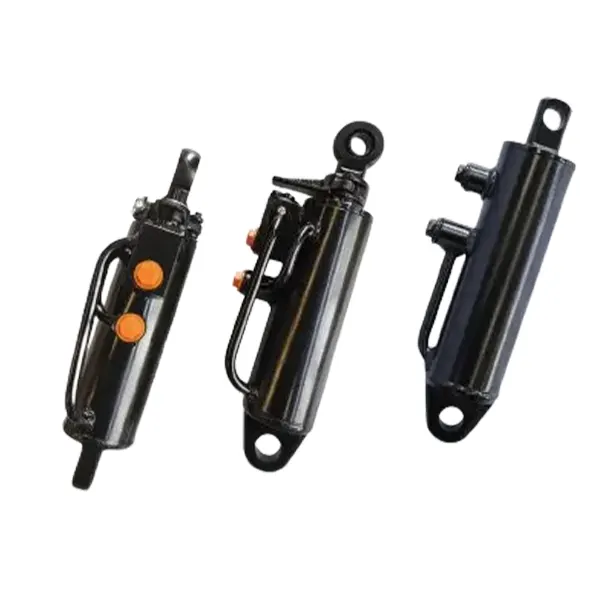
Three characteristics distinguish agricultural cylinder applications from industrial or construction applications and require specifically engineered designs rather than generic cylinders adapted from other sectors:
★ SEASONALITY
Agricultural lift cylinders compress their entire annual cycle count into 4–8 weeks of intense use — a tractor rear lift cylinder may complete more cycles during a single week of planting than a construction cylinder completes in a month. This is then followed by months of complete inactivity with the cylinder exposed to weather. Seal materials must handle both extremes: high-cycle fatigue during use and static compression-set during storage.
★ CHEMICAL EXPOSURE
Cylinders in agricultural use operate in chemical environments that do not exist in other equipment sectors — fertiliser spray, crop protection chemical residues, ammonia-based nitrogen compounds, and soil organic acids all contact the exposed rod and gland area. Standard NBR seals are resistant to mineral hydraulic oil but show accelerated degradation from concentrated fertiliser splash; polyurethane and PTFE perform significantly better in high-chemical-exposure positions.
★ LOAD VARIABILITY
Implement weight varies dramatically with soil condition — a plough pulled through heavy clay generates forces 3–5× higher than the same implement in sandy loam. This load variability creates pressure spikes that agricultural lift cylinders experience on every field boundary where soil type changes. The relief valve must be correctly set and maintained; an incorrectly set relief is the primary cause of structural cylinder failures in agricultural applications.
अनुभाग 02
Tractor Rear Lift and Three-Point Hitch Cylinders
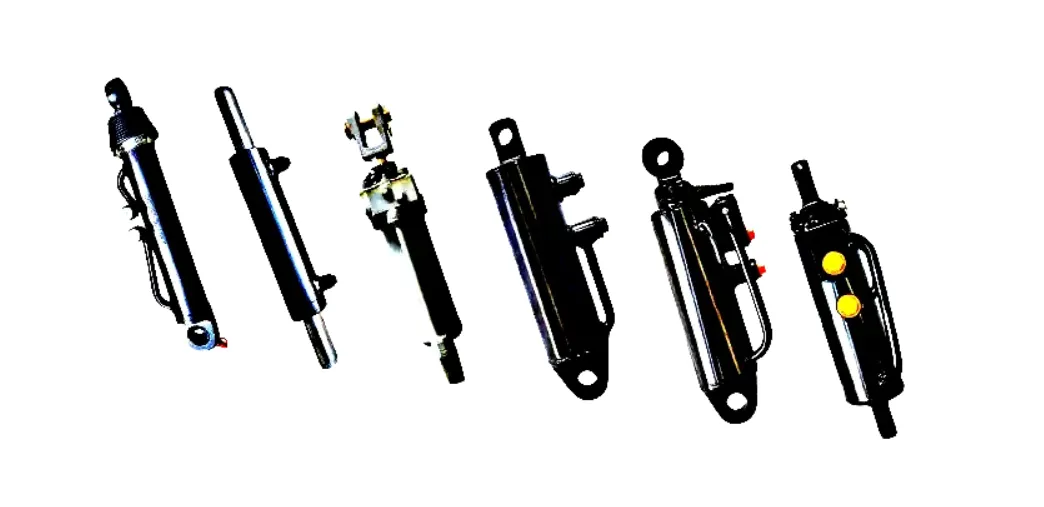
The tractor rear lift cylinder is the most versatile and highest-cycle unit in the agricultural sector — it must handle a single-day cycle count that ranges from 50 cycles (large fields, long passes) to over 600 cycles (small fields, short passes with frequent headland turns). This cycle frequency range, combined with implement weight variations from 200 kg (rotary hoe) to 6 000 kg (heavy cultivator), places this cylinder at the extremes of both cycle endurance and force requirement simultaneously.
The tractor steering and rear lifting hydraulic cylinders are engineered specifically for the three-point hitch environment. Key engineering features for this application:
HYDRAULIC CIRCUIT
Tractor rear lift cylinders operate on the tractor’s internal hydraulic system — a closed-centre or open-centre circuit with pressure typically 18–21 MPa. the bore must match the tractor’s internal circuit flow capacity: too large and the cylinder extends too slowly; too small and it extends too fast for depth control.
POSITION SENSING
Modern tractor lift systems incorporate position feedback through the three-point hitch linkage — the lift cylinder must achieve consistent, repeatable positioning to allow the tractor’s draft control system to automatically maintain implement working depth. Internal piston seal bypass compromises this repeatability.
SHOCK PROTECTION
When a tillage implement strikes a buried rock or hardpan, the shock load is transmitted directly to the lift cylinder through the three-point linkage. An internal relief valve in the lift cylinder circuit must dissipate this energy before it reaches the cylinder end-caps and rod welds — a missing or incorrectly set relief valve is the most common cause of structural failure on tractor rear lift cylinders.
अनुभाग 03
No-Tillage and Seeder Frame Lift Cylinders
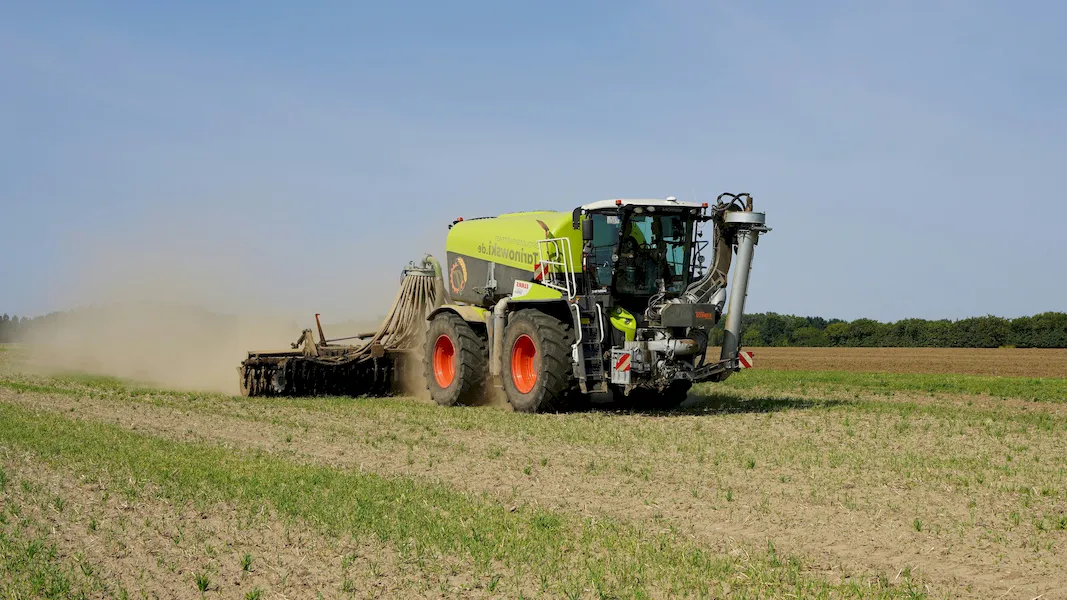
No-tillage seeders represent one of the most complex lift cylinder applications in agriculture — a single machine may use a main frame cylinder, auxiliary wing cylinders, and individual row unit depth control cylinders simultaneously, with each position having different bore requirements, load characteristics, and duty cycles. The main lift cylinder must raise the entire frame weight (often 3 000–8 000 kg) for transport and headland turns. Wing lift cylinders must independently raise and lower wing sections to follow terrain contours. Row unit cylinders provide fine depth control at each seeding position.
MAIN
FRAME LIFT
The Main frame cylinder raises the seeder from working depth to transport height — 400–600 mm of stroke lifting 3 000–8 000 kg of frame weight. Bore: 80–150 mm depending on frame weight. Single-acting hydraulic extension with spring or gravity return. It must hold the frame at transport height under road vibration for extended periods between fields — internal piston seal integrity is critical for transport safety. The full range of these single-acting cylinders is available across the लिफ्ट सिलेंडर product category.
WING
SECTION
Wing fold cylinders allow the wing sections to reduce transport width for road travel. these are typically double-acting (to both fold and unfold the wing sections reliably) with bore 60–100 mm and stroke 400–800 mm. the folded position is held under load during transport — rod seals must maintain zero leakage for several hours between fields.
ROW UNIT
DEPTH
Row unit depth cylinders at each seeding position are small-bore (40–60 mm), short-stroke cylinders that maintain consistent seeding depth as the individual row unit follows ground contours. These operate at the highest cycle frequency in the seeder — continuously adjusting as the machine traverses uneven terrain — and require high-cycle-rated polyurethane seals rather than standard NBR seals.
अनुभाग 04
Combine Harvester Header Lift Cylinders
The combine harvester header cylinder supports one of the most demanding sustained-load positions in agricultural machinery — a cutting platform weighing 2 000–6 000 kg must be raised and lowered repeatedly throughout the harvest day, and must maintain precise height control at millimetre accuracy while traversing uneven terrain at field speeds of 5–8 km/h. The cylinder on a combine harvester is almost always double-acting, because reliable retraction under load (lowering the header smoothly) is as important as reliable extension (raising it).
COMBINE HEADER LIFT CYLINDER — KEY ENGINEERING REQUIREMENTS
HEIGHT ACCURACY
Header must be maintained at ±20 mm of target cutting height. Seal bypass greater than 1 ml/min causes the header to drift below target height, resulting in soil ingestion that damages the threshing cylinder and accelerates crop losses.
FLOAT FUNCTION
Modern combine header lift cylinder circuits include a “float” function that allows the header to follow ground contours under gravity rather than hydraulic pressure. The cylinder must transition smoothly between float and active lift mode without pressure spikes that cause the header to jerk — requiring precision-machined gland fits and low-friction seal materials.
सिंक्रनाइज़ेशन
Wide headers (6–12 m) use two cylinders — one on each side. These cylinders must extend and retract synchronously to prevent lateral tilt of the header, which causes uneven cutting height and can jam the header against the crop in one-sided low spots. Rephasing circuits maintain synchronisation within ±10 mm.
अनुभाग 05
Agricultural Lift Cylinder Specification by Machine Type
| MACHINE / POSITION | BORE | प्रकार | CYCLES/DAY | KEY REQUIREMENT |
|---|---|---|---|---|
| Tractor rear hitch (50–120 HP) | 60–80 mm | Single-acting | 100–400 | Draft control integration, shock protection |
| Tractor rear hitch (120–250 HP) | 80–120 mm | Single-acting | 100–600 | High load capacity, PU rod seal for chemical exposure |
| No-tillage seeder — main frame | 80–150 mm | Single-acting | 20–80 | Load holding for transport, PU seals for fertiliser exposure |
| No-tillage seeder — row unit | 40–60 mm | Single-acting | Continuous | Ultra-high cycle, PU seals mandatory, position accuracy |
| Combine harvester — header lift | 80–120 mm | Double-acting | 50–200 | Synchronisation, float function, mm height accuracy |
| Baler plunger / knotting | 50–80 मिमी | Double-acting | High (automatic) | High cycle rate, crop debris exposure, consistent force |
| Sprayer boom fold | 50–80 मिमी | Double-acting | 4–8 | Chemical resistance (spray contact), reliable load holding |
Sourcing note: The agricultural cylinder range for mobile equipment applications — including tractor rear hitch, implement frame, and harvester header positions — is available via the मोबाइल मशीनरी हाइड्रोलिक सिलेंडर category, which covers the full range of single-acting and double-acting configurations with agricultural-rated seal specifications.
अनुभाग 06
Seasonal Service and Storage Maintenance

Agricultural cylinder maintenance follows a seasonal pattern that differs from industrial schedules. The critical service events are end-of-season (after harvest or post-planting), pre-season (before the next operational period), and in-season (during use). Each has distinct priorities:
END OF SEASON
After last use
Clean all lift cylinder exposed surfaces thoroughly — remove crop debris, soil, and chemical residues that will accelerate corrosion during storage. Retract all cylinders fully to minimise exposed rod surface. Inspect each rod for scoring, corrosion staining, or chrome damage — replace any damaged seals before storage, not at the start of next season when you need the machine immediately. Apply corrosion-preventive wax to all external cylinder surfaces and port areas. Grease all pivot pins to displace any water from the pin clearance zone.
STORAGE PERIOD
During off-season
Store all agricultural equipment in a covered, dry location where possible — outdoor storage exposes lift cylinder seals to ozone degradation, UV radiation, and freeze-thaw cycling that collectively shorten seal life by 30–50% compared to indoor storage. If outdoor storage is unavoidable, use protective covers over the extended rod area and reseal port plugs to prevent condensation ingress into the cylinder bore.
PRE-SEASON
Before first use
Extend and retract each lift cylinder through its full stroke 3–5 times before applying load — this re-lubricates the seal lips after their static storage period. Check hydraulic fluid level and clarity. Replace hydraulic filter elements if more than 6 months have passed since the last change. Verify all mounting pin retaining clips are present. Perform a full-stroke static hold test — any lift cylinder that descends more than 5 mm in 5 minutes must be inspected and repaired before field work begins.
आवेदन संबंधी अक्सर पूछे जाने वाले प्रश्न
Agricultural Lift Cylinder Questions
प्रश्न 01
Can I use a standard industrial lift cylinder as a replacement for an agricultural tractor rear lift cylinder?
Not without careful specification matching. A standard industrial cylinder may have the correct bore and stroke dimensions but will typically differ in three critical respects: the mounting eye or flange geometry (agricultural tractor cylinders use standardised pin diameters and eye width dimensions matched to the three-point linkage; industrial cylinders may use different mounting configurations); the seal specification (agricultural lift cylinders are specified with polyurethane rod seals and metal wiper scrapers for outdoor and chemical exposure; industrial cylinders often use NBR seals not rated for agricultural chemical environments); and the internal relief valve setting (agricultural hitch systems require a specific relief pressure matched to the tractor’s hydraulic system pressure — using an incorrectly set relief allows the tractor to overload the cylinder during ground engagement). Agricultural-specific cylinders are the correct solution; the dimensional and specification matching cost of adapting an industrial cylinder almost always exceeds the price difference.
प्रश्न 02
Why does my tractor’s three-point hitch lift cylinder work normally when cold but drift at operating temperature?
Temperature-dependent bypass is a classic indicator of a seal that is at the end of its service life — the seal maintains adequate contact force when cold (when the elastomer is slightly stiffer and occupies more of the groove) but loses sealing contact at operating temperature when the elastomer softens and the “compression set” accumulated over years of service allows the seal to sit too loosely in its groove. The correct diagnosis is a static hold test at operating temperature — if descent is confirmed, the piston seal requires replacement. The internal relief valve and check valve should also be tested at operating temperature to rule out bypass from those components.
प्रश्न 03
Should I use biodegradable hydraulic oil in agricultural lift cylinder systems?
Biodegradable hydraulic oils (typically vegetable-based or synthetic ester base stocks) can be used in agricultural lift cylinder circuits where there is a risk of hydraulic fluid contaminating soil or water — near drainage channels, on organically certified farms, or in environmentally sensitive areas. However, biodegradable oils have shorter change intervals than mineral oils (typically 500–1 000 hours vs 1 000–2 000 hours), are more susceptible to degradation from water contamination, and require that all seals in the system are rated for ester-type fluids — standard NBR seals swell in vegetable-based oils and must be upgraded to EPDM, PTFE, or FKM. If converting from mineral to biodegradable oil, flush the entire hydraulic circuit and reservoir before refilling — residual mineral oil contamination degrades the biodegradable oil rapidly and significantly reduces its service life.
प्रश्न 04
What is the correct hydraulic oil grade for tractor lift cylinder systems in hot climate operations?
For hot climate operation (ambient temperature above 35°C), tractor hydraulic systems should be specified with ISO 68 hydraulic oil rather than the ISO 46 that is standard in temperate climates. ISO 68 has a higher viscosity at elevated temperature — at 60°C operating temperature, ISO 68 provides approximately the same viscosity as ISO 46 does at its design operating temperature of 40°C. This ensures adequate oil film thickness at the cylinder rod and bore surfaces when the hydraulic system is running hot during sustained high-load periods. The oil change interval should be reduced to 750–1 000 hours in hot climate operation (versus 1 500 hours in temperate climates) because oxidation rate doubles for every 10°C above the oil’s optimum operating temperature, and high-ambient-temperature conditions consistently push the oil above its rated thermal range.
AGRICULTURAL LIFT CYLINDER SPECIFICATION SUPPORT
Specifying Hydraulic Cylinders for Your Agricultural Application?
Our application team specifies agricultural lift cylinders for tractor rear hitches, seeder frames, harvester headers, and baler mechanisms — matched to your machine’s hydraulic circuit and duty cycle.
संपादक: सीएक्सएम