Agricultural Haulage Equipment Series · Monograph XVII
Telescopic Bed Lift Cylinders for Agricultural Dump Trucks
Agricultural dump trucks, field transport trailers, and off-road harvest tippers operate under severe mechanical demands, transporting heavy loads of grain, wet clay, sugar beets, and organic fertilizers across unpaved field terrain. During tipping, these vehicles subject hydraulic actuators to extreme dynamic pressure spikes and side-bending loads. This 2500+ word engineering guide presents an exhaustive analysis of single-acting and double-acting welded multi-stage telescopic bed lift cylinders. We examine tipping kinematics on soft soil, 27SiMn and 42CrMo alloy steel metallurgy, root causes of cylinder barrel longitudinal cracking and oil seal blowout, heavy thick-wall sleeve mechanics, impact-resistant sealing systems, and enhanced guide overlap designs engineered to survive abrasive farm environments.
Thick-Wall Barrel Design
Seal Blowout Prevention
Engineering Specifications Matrix for Farm Dump Truck Lift Cylinders
The following engineering parameters establish the structural, metallurgical, sealing, and operational benchmarks required for multi-stage telescopic bed lift cylinders deployed in agricultural dump vehicles.
| Engineering Parameter | Agricultural Dump Truck Specification Standard |
|---|---|
| Equipment Category & Application | Agricultural Transport Vehicles / Farm Dump Trucks & Tippers |
| Subsystem Motion Profile | Bed Hoist & Box Tipping System / Multi-Stage Linear Extension Circuit |
| Hydraulic Cylinder Name | Multi-Stage Telescopic Bed Lift Cylinder (3 to 5 Stage Sleeves) |
| Action Mode & Structural Type | Single-Acting (Gravity Retraction) or Double-Acting (Hydraulic Push/Pull) |
| Manufacturing Construction | Full-Penetration Welded Base Housing & Trunnion Collar Architecture |
| Material System Metallurgy | 27SiMn Seamless Alloy Steel Tubing (GB/T 17396) or 42CrMo (GB/T 3077) |
| Surface Finish & Plating | Micro-Cracked Hard Chrome Plating (30–40 μm) / Nickel-Chrome Multi-Layer |
| Environmental Rating Class | Heavy Payload + Airborne Silica Dust + Mud & Slurry Water + Organic Acid Exposure |
| Working Conditions Profile | Raising Sticky Crop Loads (Silage, Muddy Roots) + Pressure Spikes > 35 MPa |
| Primary Failure Mitigated | Oil Seal Blowout / Rupture & Stage Barrel Longitudinal Fatigue Cracking |
| Recommended Engineering Keypoints | Heavy Thick-Wall Barrel Ratio + Impact-Resistant Cushion Seals + Enhanced Overlap |
| Nominal Operating Pressure | 18.0 MPa to 25.0 MPa (180 – 250 Bar) Working Hydraulic Relief Pressure |
Agricultural Dump Bed Kinematics and Multi-Stage Lifting Dynamics
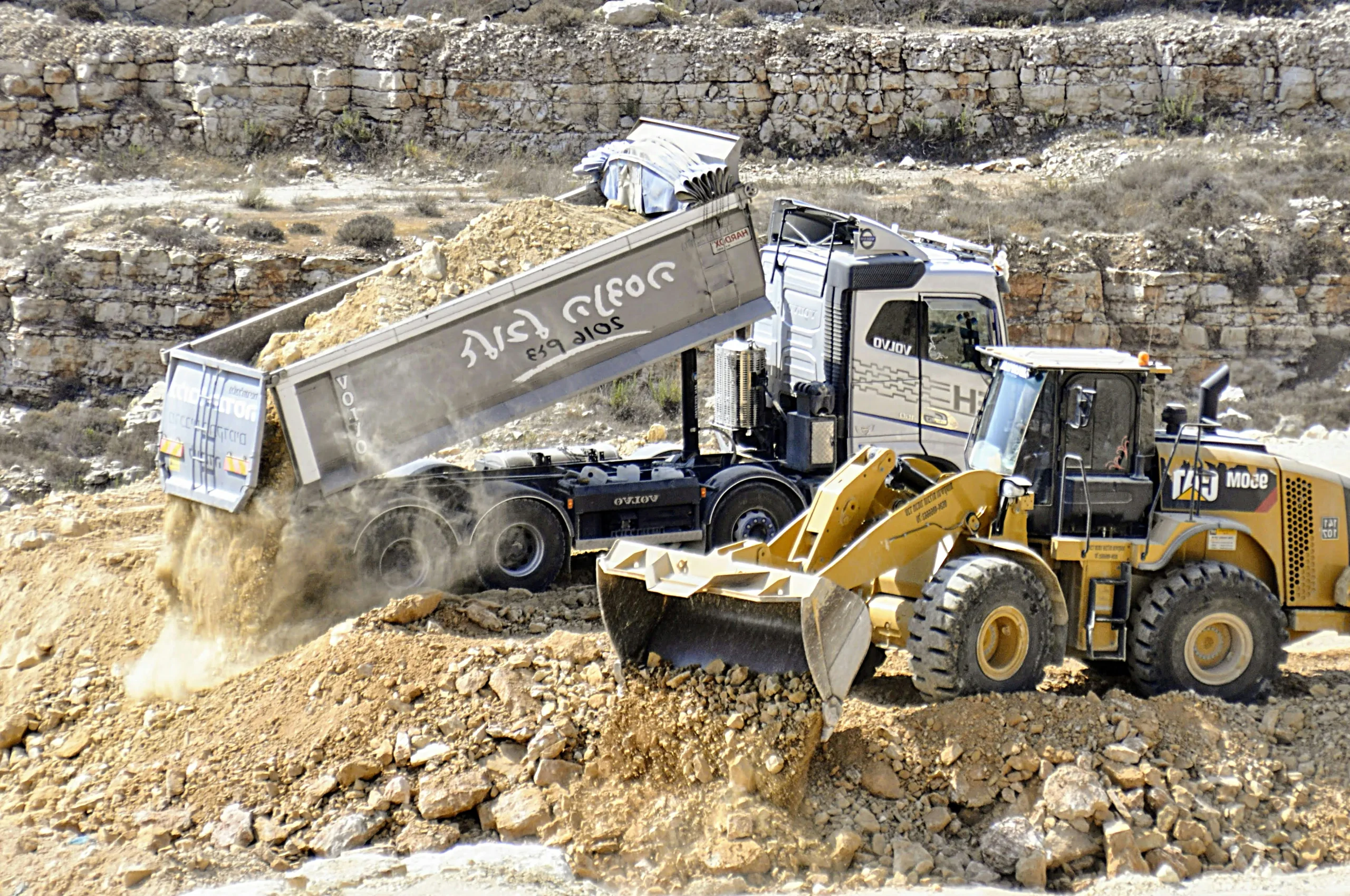
Farm dump trucks and tractor-pulled tipping trailers carry a wide variety of bulk agricultural materials. Payload densities vary dramatically—from lightweight chopped forage silage (300 to 500 kg/m³) to dense wet topsoil, gravel, and sugar beets (1,600 to 2,200 kg/m³). Elevating a fully loaded 15-to-30-ton dump bed to a discharge tilt angle of 45 to 50 degrees requires significant hydraulic thrust.
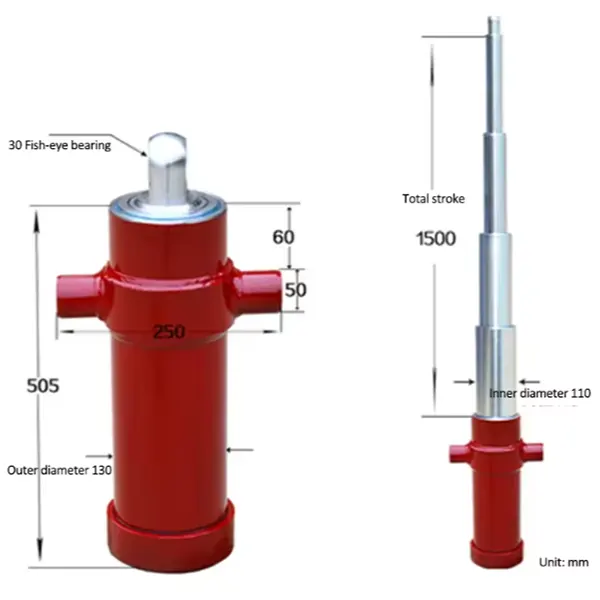
To achieve the required extended stroke length (3,000 mm to 5,500 mm) while maintaining a compact closed envelope beneath the dump bed frame, farm vehicle builders rely on multi-stage telescopic hydraulic lift cylinders. Mounted either beneath the front bulkhead (front-hoist configuration) or mid-body on trunnion mounts (underbody configuration), these actuators nest multiple tubular stage sleeves within a single main outer cylinder barrel.
Sequential Area Reduction and Hydraulic Thrust Equations
Extension order in a telescopic cylinder is dictated by effective hydraulic surface area. When pressurized hydraulic oil enters the cylinder base, it acts on all stage sleeves. Because Stage 1 possesses the largest cross-sectional surface area, it generates the highest thrust force and extends first. Once Stage 1 reaches its internal mechanical stop ring, Stage 2 extends, followed by Stage 3 and subsequent smaller stages.
The hydraulic thrust force Fthrust(i) generated at stage sleeve i is defined as:
Where Phyd is line pressure and Dstage(i) is the effective outer diameter of stage sleeve i. Thrust output decreases step-wise as each smaller stage extends. This force reduction aligns with tipping geometry: as the dump box tilts upward on its rear hinge pins, the moment arm distance between the crop load center of gravity and the rear hinge decreases, while material slides out of the tailgate, reducing the required lifting torque.
The Dynamics of Unseating Sticky Crop Payloads
A severe operational challenge in agricultural tipping occurs when handling sticky materials such as wet manure, frozen silage, or mud-laden sugar beets. These materials adhere to the front corners of the steel dump body. When the operator engages the hoist control valve, hydraulic pressure rises rapidly to overcome this static adhesion.
When the stuck load suddenly breaks free and slides backward, the loss of front mass creates a rapid momentum shift. This load bounce transmits dynamic pressure spikes (Pspike > 35.0 MPa) through the oil column, subjecting cylinder barrels and stage gland seals to severe impact loading.
Root Cause Failure Analysis: Oil Seal Blowout and Barrel Cracking (油封爆裂/缸筒裂纹)
In agricultural field operations, utility telescopic cylinders face severe shock loads and side bending. Field breakdown reports indicate two primary structural failure modes: Inter-Stage Oil Seal Blowout (油封爆裂) そして Cylinder Barrel Longitudinal Fatigue Cracking (缸筒裂纹).
Understanding these failures requires analyzing the interaction between dynamic hydraulic pressure spikes, elastic barrel expansion, and side-bending moments on soft field ground.
1. Physics of Barrel Expansion and Oil Seal Blowout (油封爆裂)
Telescopic cylinder stages consist of relatively thin-walled nested tubes. When a dynamic pressure spike (Pspike ≥ 35.0 MPa) occurs during initial load unseating, the outer parent stage sleeve acts as a pressure vessel, undergoing elastic radial hoop expansion (Δrbarrel):
Where Rinside is inner tube radius, E is the elastic modulus of the steel (206 GPa), and twall is tube wall thickness. If the wall thickness twall is undersized, radial expansion widens the clearance gap behind the gland seal.
Under high hydraulic pressure, standard polyurethane elastomer seals extrude into this widened clearance gap. As the stage retracts, the sharp metallic edge of the gland cuts off fragments of the extruded seal heel—a process known as “extrusion nibbling.” Under repeated shock cycles, the seal heel loses structural backing, resulting in high-pressure oil tearing through the seal lip (catastrophic seal blowout) and spraying hydraulic oil across the truck frame.
2. Hoop Stress Concentration and Barrel Longitudinal Cracking (缸筒裂纹)
Simultaneously, the inner wall of the seamless stage tube experiences severe circumferential hoop stress (σhoop):
When an agricultural dump truck tips a heavy load on soft, unlevel ground, side bending forces introduce additional bending stress (σbending) across the extended stage tubes. Combined hoop stress and bending stress can exceed the yield strength (σy) or fatigue limit of standard carbon steel tubing. Micro-fissures initiate on the inner tube bore, propagating outward over thousands of tipping cycles until a longitudinal fatigue crack splits open the stage wall.
Dynamic Pressure Shock
Unseating sticky crop loads generates severe pressure spikes above 35.0 MPa, forcing thin-walled stage tubes to expand radially and over-stressing seal glands.
Seal Heel Extrusion & Rupture
Expanded clearance gaps allow soft seal heels to extrude under pressure. Repeated cycles nibble away seal backing until the lip tears and blows out.
Longitudinal Tube Splitting
Combined high hoop stress and side-bending loads exceed steel fatigue limits, initiating inner-bore micro-cracks that split the barrel wall open.
Structural Metallurgy: 27SiMn and 42CrMo Alloy Steel Systems
Preventing barrel cracking and stage sleeve bending under severe agricultural tipping loads requires high core yield strength and fatigue resistance. Standard structural carbon steels (such as Q235B or AISI 1020) offer yield strengths around 235 MPa, making them unsuitable for heavy multi-stage telescopic cylinders.
High-performance agricultural dump cylinders deploy cold-drawn, normalized, or quenched-and-tempered seamless alloy tubing manufactured from “27SiMn” (Silicon-Manganese alloy steel per GB/T 17396) or “42CrMo” (Chromium-Molybdenum alloy steel per GB/T 3077 / AISI 4140).
1. 27SiMn Alloy Steel System (Silicon-Manganese Metallurgy)
27SiMn is a high-strength structural alloy steel widely specified for telescopic hydraulic cylinder barrels. Its chemical formulation balances Silicon (1.10 – 1.40%) and Manganese (1.10 – 1.40%) with Carbon (0.24 – 0.32%). Silicon elevates yield strength and elastic limit, while Manganese enhances hardenability throughout thick tube walls.
Following Quenching and Tempering (Q&T), 27SiMn delivers a yield strength (σs) ≥ 800 MPa and ultimate tensile strength (σb) ≥ 980 MPa, providing excellent resistance to pressure-induced radial expansion.
2. 42CrMo Alloy Steel System (Extreme Heavy-Duty Applications)
For ultra-heavy farm dump trucks operating on sloped terrain, 42CrMo alloy steel is specified for all stage sleeves. Chromium (0.90 – 1.20%) and Molybdenum (0.15 – 0.25%) additions provide superior hardenability, fatigue strength, and sub-zero impact toughness (≥ 45 J at -20°C).
Quenched and tempered 42CrMo achieves a yield strength (σ0.2) ≥ 850 MPa, enabling stage sleeves to flex elastically under severe side loads and return to perfect straightness without permanent bending.
| Steel Material Grade | Yield Strength (σs) | Tensile Strength (σb) | Charpy Impact Energy (-20°C) |
|---|---|---|---|
| Q235B (Standard Carbon Steel) | ≥ 235 MPa | 370 – 500 MPa | ≤ 20 J @ +20°C |
| Q345D (Low-Alloy Steel) | ≥ 345 MPa | 470 – 630 MPa | ≥ 34 J @ -20°C |
| 27SiMn Alloy Steel (Q&T) | ≥ 800 MPa | ≥ 980 MPa | ≥ 39 J @ -20°C |
| 42CrMo Alloy Steel (Q&T) | ≥ 850 MPa | ≥ 1000 MPa | ≥ 45 J @ -20°C |
Multi-Layer Nickel-Chrome Surface Protection
The outer surface of every 27SiMn or 42CrMo stage sleeve is precision ground and electroplated with a 30 μm to 40 μm layer of micro-cracked hard chrome or a duplex Nickel-Chrome coating. The nickel underlayer blocks moisture and organic acids (from liquid manure and fertilizer runoff), while the outer hard chrome layer provides a surface hardness of 58 to 62 HRC, resisting abrasive scratches from airborne sand and field mud.
Recommended Configuration: Thick-Wall Sleeves, Impact Seals, and Extended Guiding
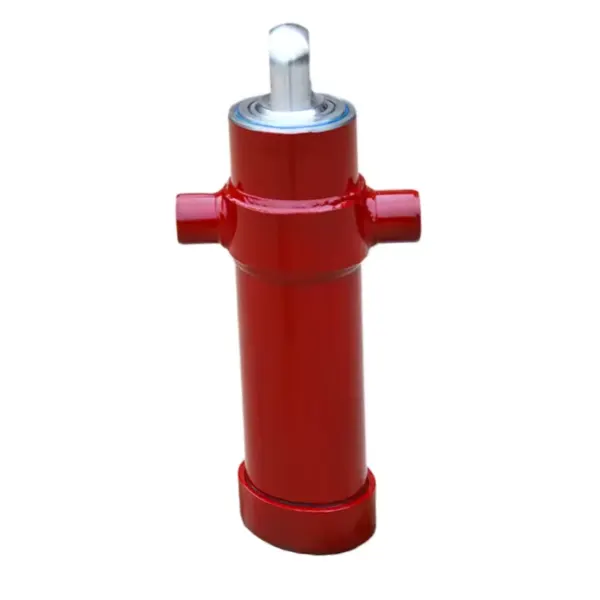
Eliminating oil seal blowout and stage barrel cracking on agricultural dump vehicles requires an engineered “Heavy-Duty Multi-Stage Configuration Package” featuring three structural upgrades: “Thick-Wall Sleeve Ratios”, “Impact-Resistant Cushion Sealing Arrays”, and “Enhanced Guide Overlap”.
1. Thick-Wall Sleeve Geometry
To prevent elastic barrel expansion under 35+ MPa pressure spikes, stage sleeve wall thickness twall is calculated using Lamé’s thick-wall equations, maintaining a wall ratio (K = Doutside / Dinside ≥ 1.30). Increasing wall thickness reduces peak hoop stress (σhoop) and restricts radial expansion (Δrbarrel) to less than 0.02 mm, keeping gland clearance gaps tight under pressure spikes.
2. Impact-Resistant Cushion Sealing Architecture
Every stage gland utilizes an engineered multi-component seal package designed to absorb dynamic pressure shocks:
- ▸
Fabric-Reinforced Multi-Lip Vee-Packing Stack: Serves as the primary pressure barrier. Rubber-impregnated cotton duck fabric lips conform under hydraulic pressure, maintaining a seal even if stage sleeves experience minor radial flexure. - ▸
PEEK Anti-Extrusion Back-Up Rings: Installed directly behind primary seals. PEEK (Polyetheretherketone) possesses a high tensile modulus (> 3,500 MPa), bridging gland clearance gaps under pressure spikes up to 40.0 MPa and preventing seal heel extrusion nibbling. - ▸
Heavy Dual-Lip Metal-Cased Scraper Seal: A polyurethane scraper ring housed in a steel shell scrapes away dried field mud, straw fibers, and quartz dust before stage sleeves retract into parent tubes.
3. Enhanced Guide Overlap & Wear Band System
To distribute lateral bending moments caused by uneven tipping on sloped ground, the internal guide overlap length between adjacent stage sleeves at full extension is extended to Loverlap ≥ 1.8 × Dステージ. Centrifugally cast bronze-filled PTFE guide bands guide stage movement, absorbing side-bending loads without scoring the hard-chromed stage surfaces.
Specifying a robust multi-stage telescopic hydraulic lift cylinder engineered with 27SiMn/42CrMo thick-wall barrels, impact seals, and extended guide overlap eliminates seal blowout and barrel cracking in heavy farm dump applications.
Preventive Maintenance, Fluid Hygiene, and Diagnostic SOP
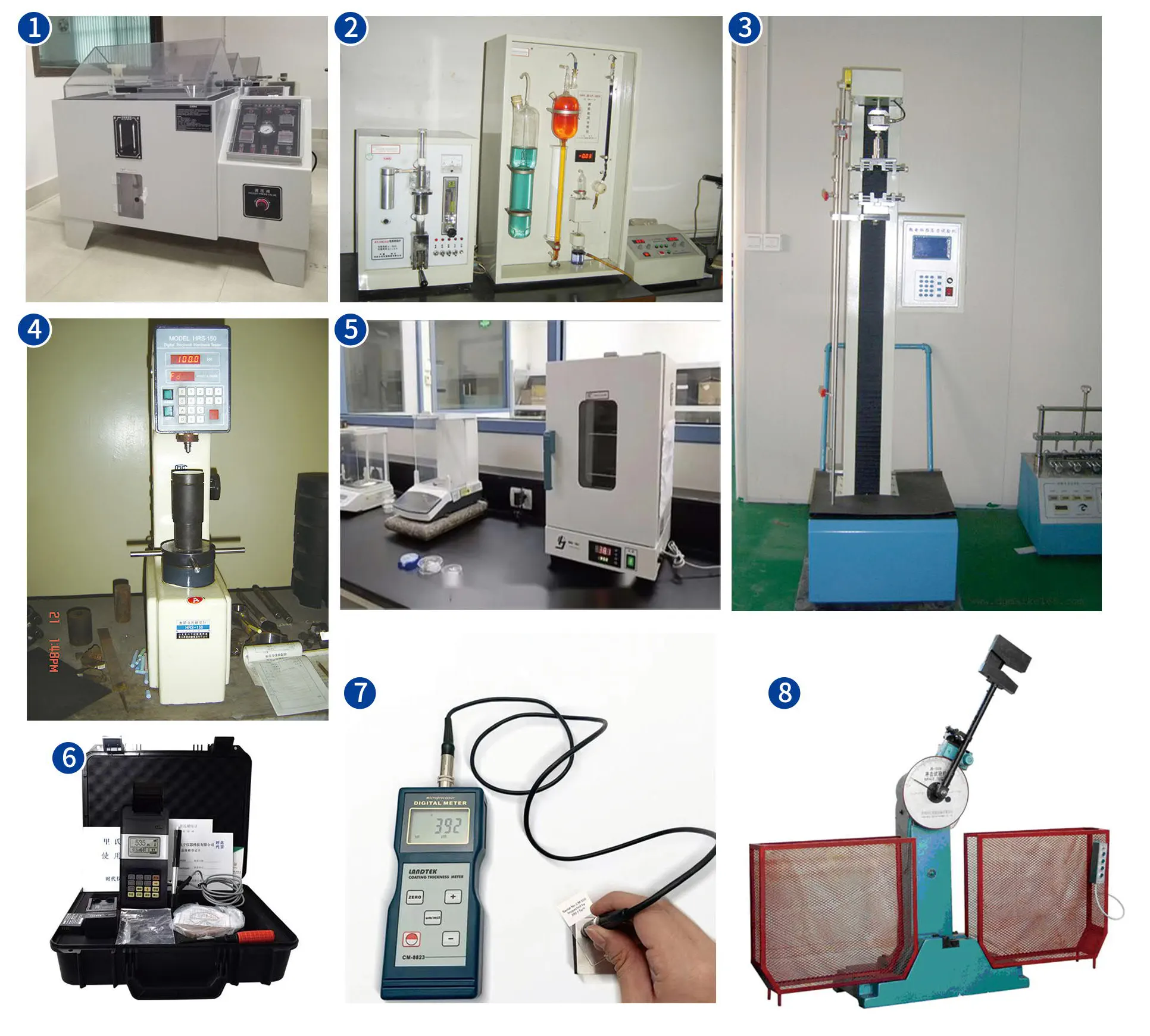
Maintaining fluid power reliability during busy harvest seasons requires strict hydraulic oil hygiene and systematic diagnostic protocols. Because single-acting telescopic cylinders cycle large oil volumes during tipping, airborne field dust can enter the reservoir if breather filtration is neglected.
ISO Cleanliness Target and Air Bleeding Protocol
Hydraulic oil in farm dump truck systems should be maintained to an ISO 4406 cleanliness code of 18/16/13 or cleaner. Contaminated oil accelerates wear on stage seals and tractor control valve spools. Trapped air inside multi-stage telescopic cylinders must be bled periodically via top vent plugs; compressed air causes erratic stage movement and violent box bouncing during unloading.
Diagnostic SOP for Inter-Stage Seal Leakage & Crack Inspection
When oil weeping or pressure loss occurs during tipping, field technicians can execute this diagnostic SOP:
1. Dye Penetrant Barrel Crack Check
Clean field dirt and oil from outer stage sleeve walls. Apply red dye penetrant followed by white developer spray along high-stress areas near gland threads and base welds. Any red line indicates longitudinal fatigue micro-cracking requiring immediate sleeve replacement.
2. Inter-Stage Seal Leakage Test
Clean all stage gland faces. Fully extend the cylinder under hydraulic pressure with an empty dump bed and lock safety support props. If oil streams continuously from a specific stage gland face, the internal Vee-packing stack or PEEK back-up ring is blown out and requires replacement.
Frequently Asked Questions: Agricultural Dump Truck Telescopic Cylinders
What causes oil seal blowout on farm dump truck telescopic lift cylinders?
Oil seal blowout on agricultural dump truck telescopic cylinders is caused by high dynamic pressure spikes (> 35.0 MPa) when initial sticky crop loads (such as wet silage or mud-laden sugar beets) unseat and slide backward. Pressure spikes force thin-walled stage tubes to expand radially, widening the gland clearance gap. Soft seal heels extrude into this expanded gap, and repeated cycling nibbles away seal backing until high-pressure oil tears through the seal lip and blows out.
How does a thick-wall barrel design prevent cylinder longitudinal fatigue cracking?
Thick-wall stage sleeve engineering (wall ratio K = D_outside / D_inside ≥ 1.30) increases structural rigidity and lowers peak circumferential hoop stress (σ_hoop) generated during pressure spikes. Restricting radial expansion to less than 0.02 mm keeps stress levels well within the fatigue limit of 27SiMn or 42CrMo steel, preventing inner-bore micro-crack initiation and longitudinal barrel splitting.
Why are 27SiMn and 42CrMo alloy steels preferred over standard carbon steel for farm dump cylinders?
27SiMn and 42CrMo alloy steels deliver yield strengths exceeding 800–850 MPa following quenching and tempering—more than triple the yield strength of standard Q235 carbon steel. They also provide high sub-zero impact toughness (≥ 39–45 Joules at -20°C). This combination prevents permanent stage sleeve bending when tipping heavy loads on soft, unlevel field ground during spring or autumn harvest conditions.
How do PEEK anti-extrusion rings and enhanced guide overlap protect telescopic cylinders on uneven ground?
PEEK (Polyetheretherketone) back-up rings feature a high tensile modulus (> 3,500 MPa) that bridges gland clearance gaps under pressure spikes up to 40.0 MPa, preventing soft elastomer seal heels from extruding. Meanwhile, enhanced guide overlap (L_overlap ≥ 1.8 × D_stage) distributes side-bending loads across centrifugally cast bronze guide bands, keeping extending stages concentric and preventing localized sleeve binding when tipping on field slopes.
Strategic Procurement and Total Cost of Ownership
For agricultural machinery manufacturers, farm equipment dealers, and crop transport contractors, unexpected cylinder failures during peak harvest seasons lead to vehicle downtime, crop spoilage, and high repair costs. Sourcing low-cost telescopic cylinders manufactured with thin-walled carbon steel or basic single-lip seals often results in repeat seal blowouts, barrel cracking, and elevated long-term operating costs.
Equipment procurement teams can evaluate technical options across agricultural machinery hydraulic cylinder options to verify material certifications, tube wall thickness specs, and pressure test reports. Equipping farm dump trucks with heavy-duty telescopic hydraulic lift cylinders for dump trucks engineered with 27SiMn/42CrMo alloy steel, thick-wall barrels, and impact-resistant seal packages ensures long-term operational reliability and lower total operating costs across harvest seasons.
Upgrade Your Farm Dump Fleet with Blowout-Proof Power
Eliminate inter-stage oil seal blowouts, prevent stage barrel cracking under pressure spikes, and maintain reliable crop tipping efficiency on soft field ground. Explore our complete series of single-acting and double-acting, 27SiMn/42CrMo multi-stage telescopic lift cylinders engineered for agricultural dump trucks.