
Municipal Maintenance Equipment Series · Monograph XXII
Aerial Boom Lift Cylinders for Street Light Maintenance Trucks
Street light maintenance trucks, municipal aerial platform vehicles, and bucket trucks perform elevated utility servicing across urban highways, residential roads, and industrial infrastructure. Operating at platform working heights between 12 and 32 meters, their hydraulic boom elevation actuators must withstand dynamic bucket positioning loads, continuous operator weight shifts, and unpredictable wind velocity shocks. This comprehensive technical guide presents a structural, metallurgical, and safety analysis of double-acting welded piston-type aerial boom lift cylinders. We explore aerial bucket kinematics, Q345D low-alloy high-strength steel metallurgy, the physics of piston rod column buckling under combined wind moments, oversized heavy-duty rod design ratios, and self-aligning spherical plain bearing joint architectures engineered to protect high-altitude municipal crews.
Oversized Heavy-Duty Rod
Spherical Plain Bearing Joints
Engineering Specifications Matrix for Street Light Maintenance Lift Cylinders
The following engineering parameters define the structural, metallurgical, sealing, and anti-buckling standards required for double-acting welded boom lift cylinders deployed on municipal aerial work trucks.
| Engineering Parameter | Municipal Aerial Vehicle Specification Standard |
|---|---|
| Equipment Category & Application | Municipal Maintenance Vehicles / Street Light Aerial Platforms & Bucket Trucks |
| Subsystem Motion Profile | Articulated / Telescopic Aerial Boom Lifting Circuit / Double-Acting Controlled Motion |
| Hydraulic Cylinder Name | Aerial Boom Lift Cylinder Assembly (Main Elevating Hydraulic Actuator) |
| Action Mode & Structural Type | Double-Acting Piston Type (High-Force Extension Elevating / Controlled Powered Lowering) |
| Manufacturing Construction | Robotic Welded Heavy-Wall Barrel & Integrated Spherical End Clevises (AWS D1.1) |
| Material System Metallurgy | Q345D Low-Alloy High-Strength Steel Tubing (GB/T 1591 / EN 10025 S355J2) |
| Surface Treatment & Plating | Induction Hardened (58–62 HRC) + Precision Hard Chrome Plating (25–35 μm) |
| Environmental Rating Class | Medium Dead Load + High Aerial Wind Load Buffeting + Sub-Zero Winter Exposure |
| Working Conditions Profile | High-Altitude Lighting Fixture Servicing + Continuous Holding + Gust Moment Buffeting |
| Primary Failure Mitigated | Piston Rod Structural Bending, Column Buckling, & Mounting Pin Binding |
| Recommended Engineering Keypoints | Oversized Heavy-Duty Piston Rod (drod / Dbore ≥ 0.65) + Spherical Plain Bearings |
| Nominal Operating Pressure | 18.0 MPa to 25.0 MPa (180 – 250 Bar) Continuous Hydraulic Working Pressure |
Aerial Boom Elevation Kinematics and Dynamic Wind Loading
Municipal street light maintenance trucks deploy articulated or telescopic boom arm systems to position utility personnel directly adjacent to elevated light heads, traffic signals, and overhead power distribution cables. Operating elevated personnel buckets introduces strict safety standards (such as ANSI/SAIA A92.2 and EN 280), where structural deflection or hydraulic instability poses immediate life-safety risks.
The primary elevation of the main boom structure is actuated by double-acting hydraulic lift cylinders mounted between the rotating pedestal base and the lower boom section. These cylinders must hold the elevated structure steady for extended periods while supporting personnel, tools, and replacement lighting fixtures.
Dynamic Wind Pressure and Overturning Moments
Unlike earthmoving machinery operating near ground level, aerial work vehicles are exposed to high wind velocities at elevation. Aerodynamic drag acting on the elevated boom structure, personnel bucket, and technicians generates dynamic wind pressure (q):
Where ρair is air density (1.225 kg/m³) and vwind is gust wind velocity. For a bucket truck operating in Beaufort Force 6 winds (vwind = 12.5 m/s), wind drag creates a lateral force (Fwind) acting across the projected area of the elevated boom and bucket (あprojected):
Where Cd is the aerodynamic drag coefficient. When the elevated boom is angled at θ = 45° to 70°, this lateral wind force creates a severe side-bending moment (Mwind) transmitted directly into the fully extended piston rod of the boom lift cylinder.

Double-Acting Hydraulic Thrust Equations
To elevate and lower the boom under full load, double-acting piston cylinders generate linear push force (Fpush) during extension and powered pull force (Fpull) during retraction:
Where Phyd is system line pressure (18.0 to 25.0 MPa), Dbore is the inner cylinder bore diameter (100 mm to 160 mm), and drod is the piston rod outer diameter (65 mm to 110 mm). Integrated pilot-operated counterbalance valves mounted directly onto the cylinder cap port prevent free-fall in the event of hydraulic hose rupture.
Root Cause Failure Analysis: Piston Rod Bending and Buckling Mechanics
In high-reach municipal aerial bucket trucks, lift cylinders operate near full stroke extension (L脳卒中 = 1,200 mm to 2,200 mm). Field failure reports show that Piston Rod Permanent Bending and Column Buckling Failure is a critical structural risk when standard utility cylinders are exposed to severe lateral wind loads and rigid pin binding.
Understanding rod deformation requires evaluating the combined interaction of axial compressive load, wind-induced lateral bending moments, and pin-joint mechanical binding.
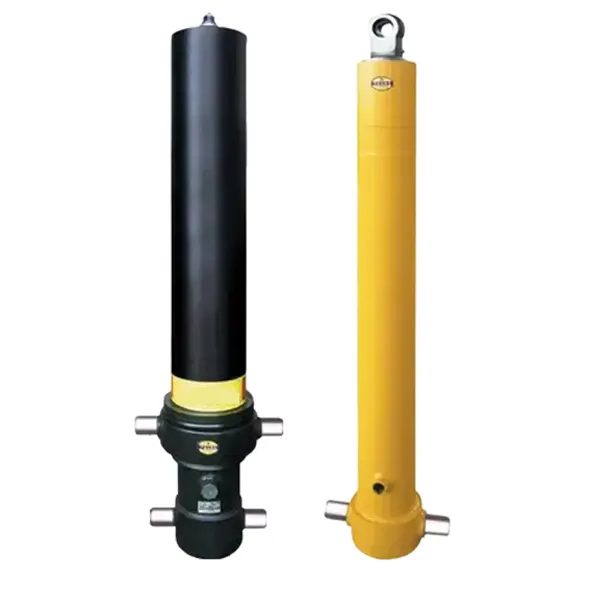
1. Euler-Johnson Column Buckling Mechanics
A fully extended hydraulic cylinder acts as a pin-ended slender column subjected to heavy axial compression (Paxial). The critical Euler buckling load (Pcr) is defined as:
Where E is the elastic modulus of steel (206 GPa), 私rod is the area moment of inertia of the solid piston rod (私rod = π × drod4 / 64), K is the end-fixity factor (K = 1.0 for pin-jointed clevises), and Lextended is the total extended pin-to-pin length. If the rod diameter drod is undersized, 私rod drops by a fourth-power factor, drastically reducing Pcr.
2. Combined Axial Stress and Wind Bending Moments
When strong wind gusts hit an elevated aerial bucket, lateral wind forces generate an additional lateral bending moment (Mwind). The maximum combined outer-fiber tensile/compressive stress (σmax) across the rod surface becomes:
If σmax exceeds the material yield strength (σs), the outer fibers of the piston rod undergo plastic yielding. The rod suffers permanent curvature bending, causing dynamic gland jamming, seal scoring, and loss of boom control.
3. Rigid Pin Misalignment and Torsional Binding
Standard rigid cylindrical pin clevises allow rotation in only one plane. When an aerial boom structure twists slightly due to asymmetric bucket loads or vehicle frame chassis flexure, rigid pin joints bind within their mounting brackets. This joint binding introduces intense out-of-plane bending moments directly into the cylinder rod end, accelerating rod bending failure.
1. Dynamic Wind Buffeting
High-altitude wind gusts generate severe lateral forces against elevated buckets, imposing large side-bending moments across fully extended piston rods.
2. Rigid Pin Binding
Chassis flexure and asymmetric bucket loads induce out-of-plane angular misalignment, causing rigid cylindrical mounting pins to bind and bend the rod.
3. Plastic Rod Curvature
Combined compressive stress and lateral bending stress exceed the steel yield point, causing permanent rod bending, gland seizure, and cylinder lockup.
Structural Metallurgy: Q345D Low-Alloy Steel & Surface Tribology
Municipal maintenance vehicles operate outdoors year-round across wide temperature ranges (-25°C winter freezing to +45°C summer heat). Standard carbon structural steels (such as Q235B or AISI 1020) lose impact toughness at sub-zero temperatures, making welded joint seams susceptible to brittle fatigue cracking under dynamic wind shocks.
High-reach street light maintenance cylinders deploy “Q345D low-alloy high-strength structural steel” (conforming to GB/T 1591, equivalent to EN 10025-3 S355J2G3) for the welded outer barrel, base caps, and spherical mounting clevises.
Micro-Alloying and Sub-Zero Impact Toughness
Q345D utilizes a fine-grained ferrite-perlite microstructure fortified with precise micro-alloying additions of Manganese (1.00 – 1.60%), Silicon (≤ 0.55%), and trace Vanadium/Niobium. Quality Class “D” specification mandates a guaranteed Charpy V-notch impact energy absorption of あv ≥ 34 Joules at -20°C.
The material’s yield strength (σs ≥ 345 MPa) and tensile strength (σb = 470 – 630 MPa) ensure structural margin against pressure surges, while low carbon equivalent (Ceq ≤ 0.38%) guarantees 100% sound robotic full-penetration seam welds.
| Steel Material Grade | Yield Strength (σs) | Tensile Strength (σb) | Charpy Impact Energy (-20°C) |
|---|---|---|---|
| Q235B (Standard Carbon Steel) | ≥ 235 MPa | 370 – 500 MPa | ≤ 20 J @ +20°C |
| Q345D Low-Alloy Steel (Normalized) | ≥ 345 MPa | 470 – 630 MPa | ≥ 34 J @ -20°C |
| 42CrMo Alloy Steel (Q&T Rods) | ≥ 850 MPa | ≥ 1000 MPa | ≥ 45 J @ -20°C |
Induction Hardened Hard Chrome Plating Tribology
The solid piston rod is manufactured from quenched-and-tempered 42CrMo alloy steel. The rod surface undergoes medium-frequency induction hardening to create a 2.5 mm to 4.0 mm deep hardened outer case at 58 to 62 HRC, resisting impact indentations from falling tools or tree branches.
Following centerless grinding to Ra ≤ 0.15 μm, the rod is electroplated with a 25 μm to 35 μm micro-cracked hard chrome layer (400 to 600 micro-cracks/cm). The micro-cracks retain hydraulic oil films, reducing dynamic seal friction and passing 120-hour neutral salt spray corrosion testing (ISO 9227 Rating 10 performance).
Recommended Configuration: Oversized Rod Engineering & Spherical Joints
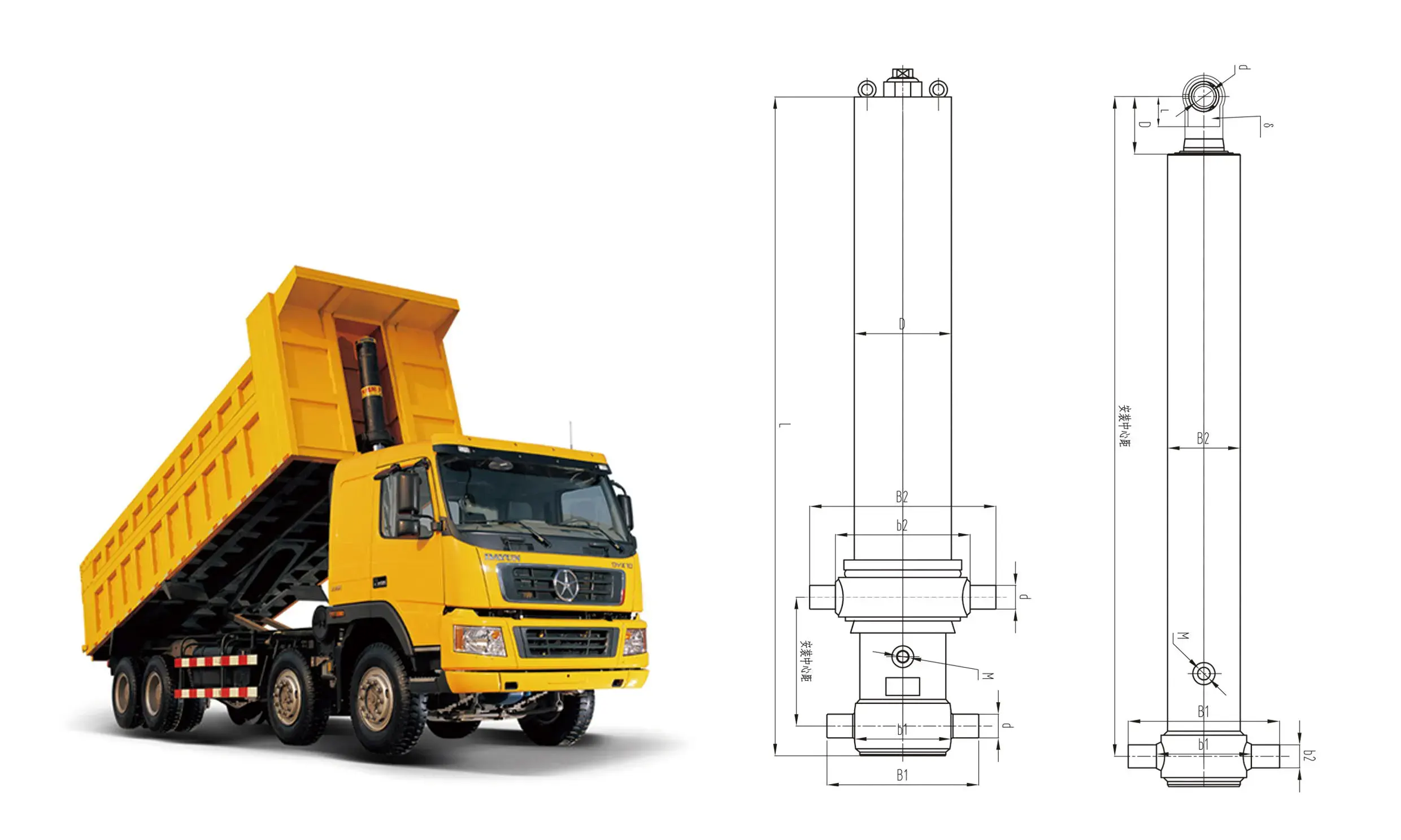
Eliminating piston rod bending, column buckling, and pin binding in street light maintenance boom lift cylinders requires an engineered “Anti-Bending Configuration Package” featuring two critical mechanical upgrades: “Oversized Heavy-Duty Rod Ratios” and “Self-Aligning Spherical Plain Bearing Joints”.
1. Oversized Heavy-Duty Piston Rod Ratios (drod / Dbore ≥ 0.65 to 0.75)
To maximize column resistance against Euler buckling (Pcr) and wind-induced bending moments (Mwind), the piston rod diameter (drod) is enlarged relative to the inner bore diameter (Dbore), maintaining a rod ratio of drod / Dbore ≥ 0.65 to 0.75 (e.g., a 90 mm rod on a 125 mm bore cylinder).
Because area moment of inertia 私rod = π × drod4 / 64 scales to the fourth power of diameter, increasing rod diameter by 25% doubles the rod’s bending resistance and critical buckling limit, guaranteeing zero plastic deformation under severe wind buffeting.
2. Self-Aligning Spherical Plain Bearing Mounts (GE Series Ball Joints)
To eliminate binding forces caused by chassis twisting and boom deflection, both the rod-end clevis and base-end mounting eye replace rigid cylindrical pin bushings with maintenance-free “Self-Aligning Spherical Plain Bearings (Radial Ball Joints / GE Series)”:
- ▸
Multi-Axis Angular Self-Alignment (±5° to ±8°): Spherical ball joints accommodate multi-directional angular misalignment caused by boom flexure, preventing torsional bending moments from transferring into the piston rod. - ▸
PTFE-Lined Self-Lubricating Sliding Interface: Inner spherical rings articulate against steel-backed PTFE composite liners, eliminating grease maintenance and pin galling in outdoor municipal environments. - ▸
Extended Gland Bearing Overlap (Lguide ≥ 1.8 × drod): Centrifugally cast bronze-filled PTFE wear bands inside the gland sleeve distribute remaining side forces uniformly over a wide support length.
Specifying a robust welded hydraulic boom lift cylinder engineered with Q345D steel, oversized 42CrMo rods, and self-aligning spherical bearings guarantees life-safety structural integrity during high-altitude municipal maintenance operations.
Preventive Maintenance, Fluid Hygiene, and Diagnostic SOP
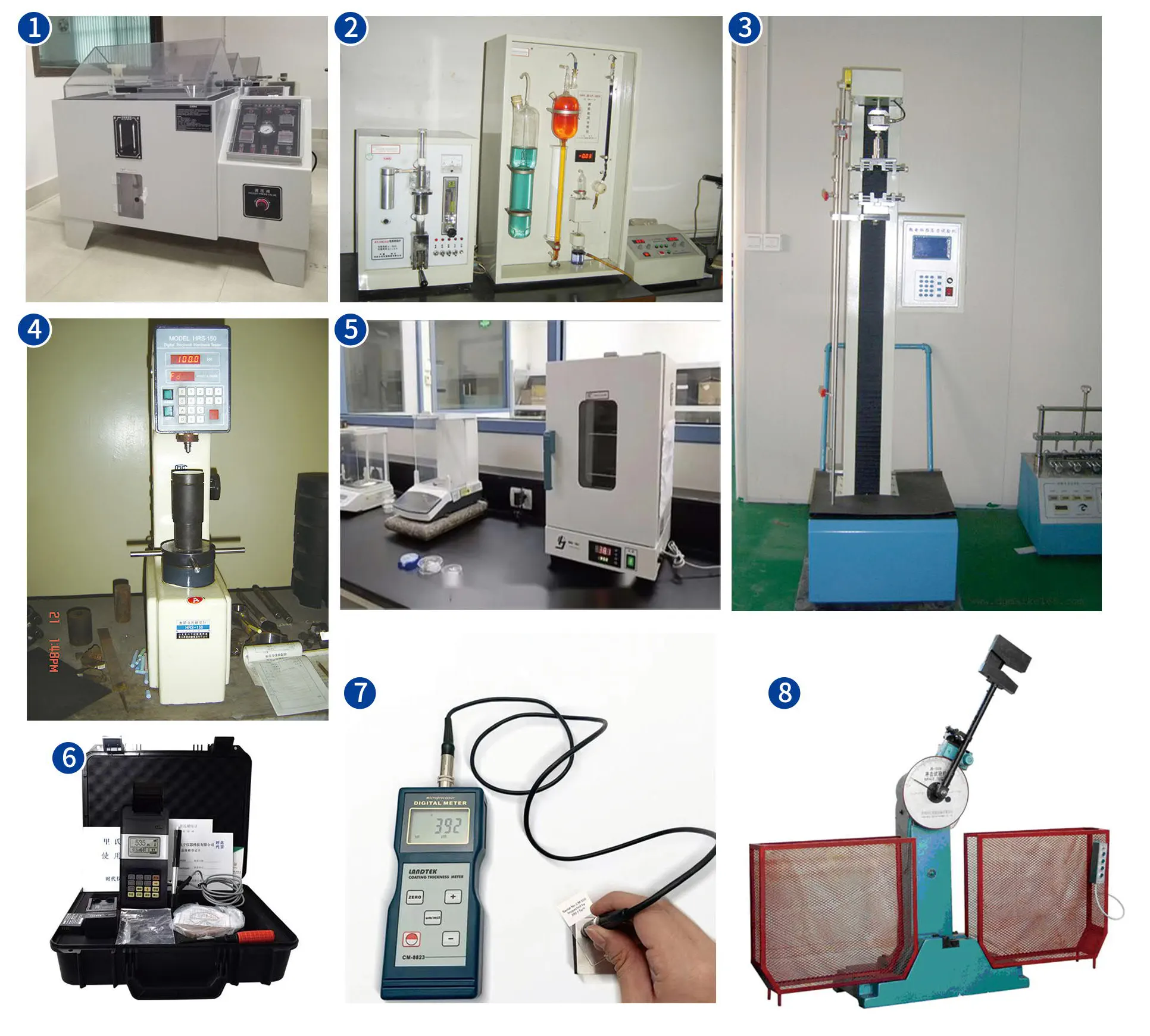
Maintaining personnel lift safety requires strict adherence to preventive hydraulic maintenance and non-destructive testing routines.
ISO Cleanliness Target and Counterbalance Valve Check
Hydraulic oil in aerial work platforms must be maintained to an ISO 4406 cleanliness code of 16/14/11 or cleaner. Direct-flanged load-holding counterbalance valves should be tested annually for zero-leak holding performance to prevent uncommanded platform drift.
Step-by-Step Diagnostic SOP for Rod Straightness & Weld Integrity
Municipal workshop mechanics can perform annual safety inspections on aerial boom lift cylinders using this diagnostic routine:
1. Precision Straightness Runout Check
Fully extend the boom lift cylinder under no-load conditions and support the assembly safely. Mount a magnetic dial indicator against the chrome rod surface and rotate or sweep along the 1,500 mm stroke length. Any Total Indicated Runout (TIR) exceeding 0.25 mm per meter indicates plastic rod bending requiring immediate rod replacement.
2. Magnetic Particle Weld Seam Crack Inspection
Clean grease and road grime from base clevis welds and cylinder head threads using solvent. Apply magnetic particle inspection (MPI per ISO 9934) across high-stress welded seams. Any indication of transverse fatigue micro-cracking mandates immediate cylinder removal and replacement.
Frequently Asked Questions: Street Light Maintenance Lift Cylinders
What causes piston rod bending on street light maintenance truck boom lift cylinders?
Piston rod bending on street light maintenance cylinders is caused by dynamic side-bending loads generated by high-altitude wind gusts acting against elevated personnel buckets, combined with rigid pin-joint binding. When a fully extended cylinder experiences combined axial compression and wind-induced lateral bending moments, outer-fiber stress can exceed the yield strength of undersized rods, resulting in permanent curvature bending.
How do self-aligning spherical plain bearing joints prevent boom cylinder failure?
Self-aligning spherical plain bearings (GE series ball joints) provide ±5° to ±8° of multi-axis angular movement. As elevated aerial booms twist or flex under wind buffeting and asymmetric bucket loads, spherical bearings articulate freely, preventing harmful torsional binding moments from transferring into the piston rod and gland assembly.
Why is Q345D low-alloy steel preferred over standard carbon steel for aerial work platform cylinders?
Q345D low-alloy steel delivers a yield strength exceeding 345 MPa and guaranteed Charpy V-notch impact toughness of あv ≥ 34 Joules at -20°C. This combination prevents elastic tube expansion under pressure surges and eliminates brittle fatigue cracking in welded seam joints during sub-zero winter municipal utility servicing.
How does an oversized rod ratio (drod / Dbore ≥ 0.65) increase column buckling resistance?
The critical Euler buckling load (Pcr = [π2 × E × 私] / [K × L]2) depends directly on the area moment of inertia (私rod = π × drod4 / 64). Because 私rod scales to the fourth power of diameter, increasing the rod ratio to drod / Dbore ≥ 0.65 to 0.75 doubles bending resistance and critical buckling thresholds, preventing rod deformation during high-reach operations.
Strategic Procurement and Total Cost of Ownership
For municipal fleet managers, aerial bucket truck OEMs, and utility maintenance contractors, unexpected boom cylinder failure represents a severe life-safety hazard and results in expensive vehicle downtime. Sourcing low-cost commodity cylinders built with standard carbon steel or narrow cylindrical pin joints leads to repeated rod bending, pin binding, and elevated long-term maintenance costs.
Fleet procurement teams can evaluate technical options across aerial work vehicle hydraulic cylinder options to verify material impact certifications, rod buckling calculations, and non-destructive weld test reports. Equipping municipal street light trucks with heavy-duty welded hydraulic lift cylinders engineered with Q345D steel, oversized 42CrMo rods, and self-aligning spherical plain bearings ensures long-term operational safety and lower total operating costs across municipal maintenance cycles.
Upgrade Your Municipal Fleet with Buckling-Proof Safety
Eliminate piston rod bending, eliminate pin-joint binding under dynamic wind loading, and ensure complete operator safety during high-altitude street light servicing. Explore our complete series of double-acting, Q345D oversized-rod boom lift cylinders engineered for aerial maintenance trucks.














