Heavy Earthmoving Machinery Series · Monograph XII
Cilindri di sollevamento per raschiatori
Wheel tractor-scrapers represent the most intensive earthmoving machines in large-scale civil engineering, capable of cutting, loading, hauling, and spreading thousands of cubic meters of dense soil per shift. This 2500+ word technical guide examines the structural mechanics, material science, and tribological engineering of double-acting welded bowl lift cylinders. We analyze high-speed bowl cutting dynamics, Euler column buckling mechanics, 42CrMo alloy steel heat treatment, reinforced thick-wall barrel hoop stress calculations, and advanced methods to prevent piston rod bending and mid-stroke fluid bypass under extreme dynamic shock loads.
Reinforced Barrel Design
Buckling Prevention
Engineering Specifications Matrix for Scraper Lift Cylinders
The following engineering parameters establish the structural, material, sealing, and operational benchmarks required for high-capacity double-acting bowl lift cylinders deployed in open-bowl and elevating wheel tractor-scrapers.
| Parametro ingegneristico | Wheel Tractor-Scraper Specification Standard |
|---|---|
| Categoria e applicazione delle apparecchiature | Heavy Construction & Mining / Wheel Tractor-Scraper Earthmoving |
| Profilo di movimento del sottosistema | Bowl Lift & Cutting Elevation Circuit / Double-Acting Linear Motion |
| Nome del cilindro idraulico | Scraper Bowl Lift Cylinder Assembly (Left & Right Pair) |
| Modalità di azione e tipologia strutturale | Double-Acting Piston Type (High-Force Push & Pull Capabilities) |
| Costruzione industriale | Robotic Full-Penetration Welded Heavy-Wall Architecture (AWS D1.1) |
| Metallurgia dei sistemi di materiali | 42CrMo High-Strength Alloy Steel (Quenched & Tempered Bar & Tube) |
| Surface Treatment & Case Depth | Hard Chrome Plating (30–40 μm) / HRC 58–62 Induction Hardened Case |
| Classe di valutazione ambientale | Extreme Dynamic Impact + Heavy Payload Vibration + Airborne Quartz Dust |
| Profilo delle condizioni di lavoro | High-Speed Earth Cutting (8-15 km/h) + Severe Boulders & Stumps Impact |
| Guasto primario mitigato | Piston Rod Bending / Column Buckling & Barrel Ovalization Distortion |
| Recommended Configuration Keypoints | Reinforced Heavy-Wall Barrel + Elongated Gland Guide & Buffer Seal Array |
| Pressione operativa nominale | 25.0 MPa to 31.5 MPa (250 – 315 Bar) Continuous Hydraulic Relief Setting |
Scraper Bowl Kinematics and Lift Actuation Hydraulics
Wheel tractor-scrapers are unique among heavy construction machines because they combine digging, loading, hauling, and dumping into a single continuous work cycle. A standard open-bowl scraper consists of a two-axle or three-axle tractor unit connected via a heavy draft frame and gooseneck hitch to a trailing bowl assembly. The main working element is the bowl cutting edge, which lowers into the ground to cut and scoop dirt during the loading phase.
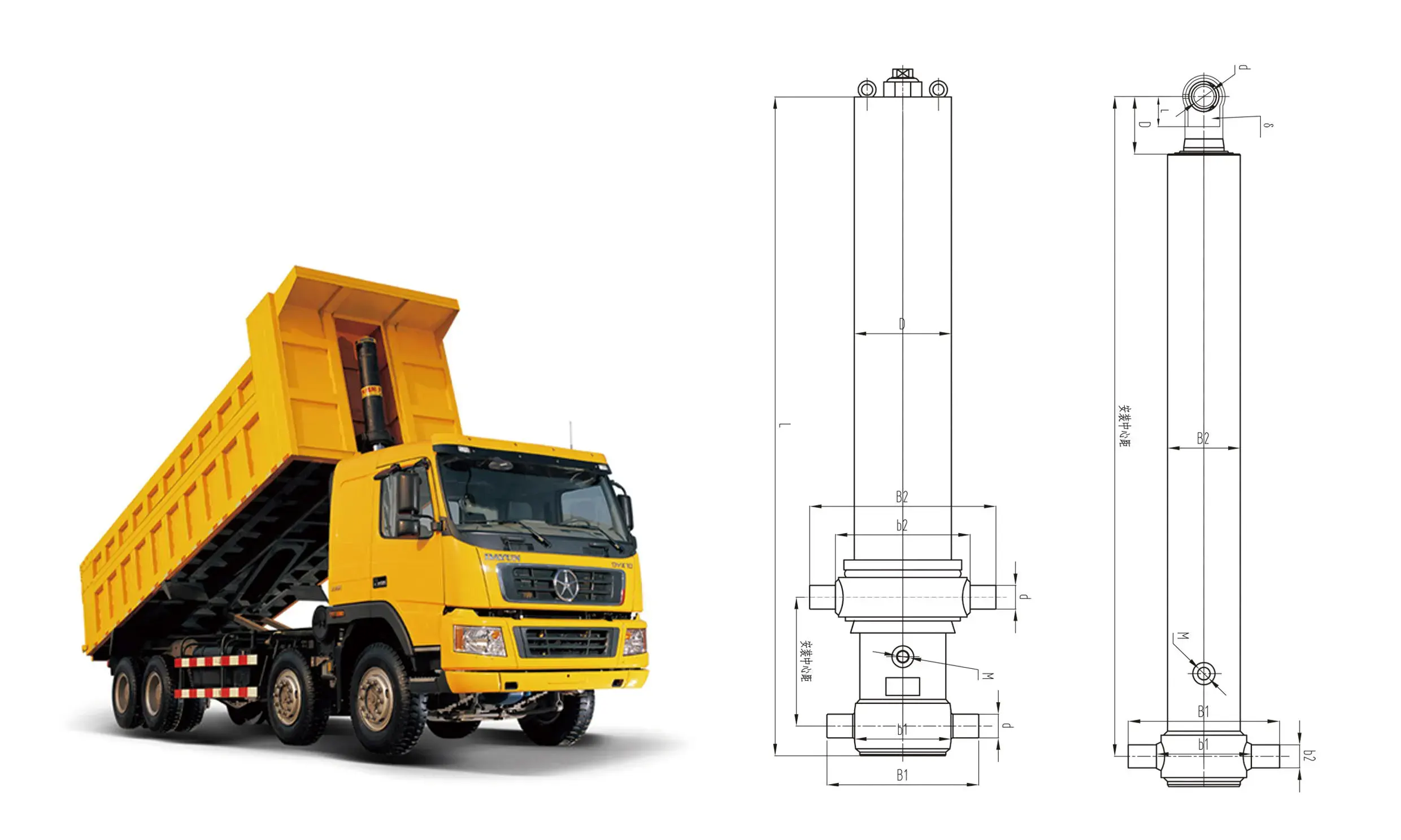
The vertical elevation, cutting depth control, and transport carry height of the heavy bowl assembly are governed by two heavy-duty cilindri idraulici di sollevamento mounted on the draft frame gooseneck. These bowl lift cylinders work in tandem with the apron lift cylinder and ejector cylinder to coordinate the loading and unloading sequence.
The High-Speed Cutting and Loading Phase
During the cut phase, the tractor drives forward at speeds between 5 and 12 km/h. The operator extends the bowl lift cylinders under power, forcing the hardened steel cutting blade deep into hard clay, shale, or compacted gravel. As the tractor advances, soil is forced upward into the bowl under immense earth pressure.
Once the bowl is fully loaded—carrying payloads that can exceed 30 to 45 metric tons—the lift cylinders are commanded to retract under high system pressure. Retraction lifts the heavy, soil-filled bowl off the ground into its carry position, allowing the scraper to haul the load at speeds up to 50 km/h over rough haul roads.
Double-Acting Force Dynamics and Pressure Equations
Scraper bowl lift cylinders are constructed as double-acting welded piston cylinders to provide controlled force in both extension (downward cutting down-pressure) and retraction (lifting heavy loaded bowl). The force outputs generated during extension Festensione and retraction Fretraction are governed by the effective hydraulic chamber areas:
Dove Pcappello e Pasta are working circuit pressures (typically 25.0 to 31.5 MPa), Dforo is the inner cylinder barrel diameter (160 mm to 240 mm for large scrapers), dasta is the solid piston rod outer diameter (100 mm to 140 mm), and Fdrag represents mechanical friction generated by seals and wear bands.
Failure Mechanics: Euler Buckling and Piston Rod Bending
During high-speed cutting operations, scraper bowl lift cylinders are subjected to extreme dynamic shock loads. When a scraper enters a cut at 10 km/h and its cutting edge strikes an embedded granite boulder, tree stump, or hardpan ledge, a massive deceleration force transfers directly through the bowl frame into the extended lift cylinder rods.
Under these severe impact conditions, the predominant structural failure mode is Piston Rod Bending (Column Buckling). An extended lift cylinder acts as a slender compression column pinned at both ends by mounting clevises.
Euler Critical Buckling Load Mechanics
The maximum compressive axial force Pcr that an extended piston rod can withstand before undergoing elastic buckling is defined by Euler’s column equation, modified for hydraulic cylinder boundary conditions:
Where E is the elastic modulus of the steel rod (206 GPa for alloy steel), I = π × dasta4 / 64 is the area moment of inertia of the solid rod, Lextended is the extended distance between pin centers, and K is the end-fixity factor dictated by spherical mounting bearings (typically K ≈ 1.0 for swivel eye mounts).
Asymmetrical Rock Strikes and Eccentric Moment Stress
In field operations, pure axial loading rarely occurs. If only the left corner of the scraper cutting edge strikes a rock, an asymmetrical force distribution twists the draft frame. This creates an eccentric moment load that acts off-center from the cylinder longitudinal axis at a distance e.
The combined maximum stress σmassimo experienced within the outer fiber of the piston rod is evaluated using Secant formula principles:
Dove Aasta is the rod cross-sectional area. If the combined stress σmassimo supera la resistenza allo snervamento (σy) of the steel material, the rod undergoes permanent bending deformation. Even a minor permanent bend of 0.5 mm causes high side loads on the gland bearing rings, crushing seals and causing severe hydraulic oil leaks.
Recommended Configuration: Heavy Thick-Wall Barrel and Reinforced Guiding
To mitigate piston rod bending and withstand the severe dynamic pressure spikes encountered during high-speed cutting operations, scraper bowl lift cylinders require an engineered “Reinforced Thick-Wall Barrel Design” paired with an “Elongated Gland Guiding System”.
Heavy Thick-Wall Barrel Design Criteria
When the cutting blade strikes a boulder at high speed, hydraulic fluid trapped inside the cap-end chamber experiences a sharp pressure spike that can exceed 40.0 MPa before the relief valve can open. Standard thin-walled cylinder barrels deform elastically under these spikes, expanding radially and causing fluid to bypass the piston seals.
Reinforced scraper cylinders utilize heavy-wall seamless tubing engineered according to Lamé’s thick-wall equations. The hoop stress σhoop across the barrel inner wall is controlled by increasing the wall thickness ratio (K = Doutside / Dinside ≥ 1.30):
Maintaining a heavy wall thickness prevents barrel flexure and ovalization, ensuring the inner bore remains concentric so the main piston seals maintain continuous sealing contact under extreme pressure spikes.
Elongated Gland Bearing Overlap and Buffer Seal Protection
To distribute side loads caused by asymmetrical rock impacts, the cylinder head gland features an extended guide overlap distance (Lsovrapposizione / Dforo ≥ 1.5). The gland incorporates a heavy-duty sealing and guiding configuration:
- ▸
Centrifugally Cast Bronze Guide Bushes: High-tensile manganese bronze or aluminum bronze sleeves inserted into the gland body absorb side loads without galling the hard-chromed rod surface. - ▸
Primary Buffer Seal with Integrated Relief Passage: Positioned upstream of the main U-cup rod seal. It absorbs high pressure spikes, venting trapped fluid back to the main system if inter-seal pressure rises excessively. - ▸
Heavy Metal-Cased Scraper Seal: An aggressive polyurethane scraper ring with a steel cage scrapes away packed mud, dried clay, and quartz sand before the rod retracts into the gland.
Specifying a reinforced front top lifting cylinder assembly engineered with a thick-wall barrel and extended gland guide overlap helps prevent piston rod bending and extends service life in heavy earthmoving operations.
Metallurgical Science: The Superiority of 42CrMo Steel
Preventing piston rod bending under heavy impact loads requires high core yield strength. Standard carbon structural steels (such as AISI 1045 or ST52-3) offer yield strengths around 350 to 450 MPa, making them susceptible to permanent bending when a high-speed scraper strikes a rock obstacle.
Scraper lift cylinders deploy acciaio legato 42CrMo (conforming to GB/T 3077, equivalent to AISI 4140 / 42CrMo4) for both the heavy-wall seamless barrel tube and the solid forged piston rod.
Thermal Processing: Quenching, Tempering, and Induction Hardening
Raw 42CrMo bar stock undergoes full Quenching and Tempering (Q&T). The material is austenitized at 850°C to 880°C, quenched in polymer or oil to produce a martensitic grain structure, and tempered at 560°C to 620°C. This heat treatment raises the core yield strength (σ0.2) to over 850 MPa and ultimate tensile strength (σB) to over 1000 MPa, with Charpy V-notch impact toughness exceeding 45 J at -20°C.
Following Q&T processing, the solid piston rod undergoes medium-frequency induction hardening to a depth of 2.5 mm to 4.0 mm, achieving a surface hardness of 58 to 62 HRC. This creates a hard outer shell that resists surface indentations from rock impacts, supported by a tough core that absorbs dynamic shock loads without snapping.
Controlled Micro-Cracked Hard Chrome Plating
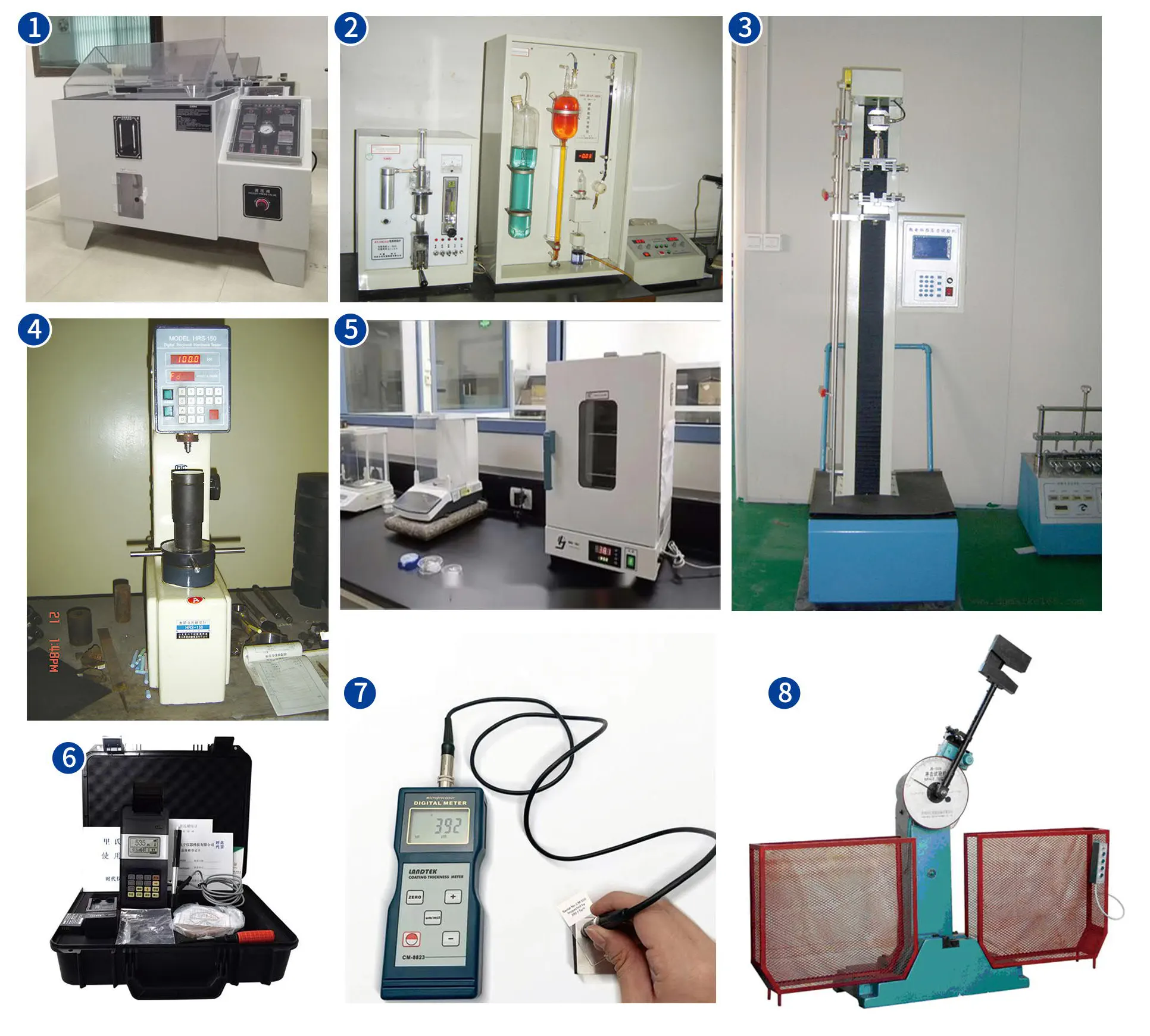
The induction-hardened rod is precision ground and electroplated with a 30 μm to 40 μm layer of hard chromium. The plating process is managed to produce a micro-cracked structure containing 400 to 600 micro-cracks per linear centimeter. These micro-fissures retain hydraulic oil via capillary action, maintaining a lubricating oil film across the rod surface during operation and passing 96-hour neutral salt spray corrosion testing in accordance with ISO 9227 standards.
Procedure operative standard (SOP) per la manutenzione preventiva, l'igiene dei fluidi e la diagnostica.
To ensure reliable operation in high-production earthmoving environments, scraper hydraulic systems require regular fluid maintenance and diagnostic monitoring. Scraper hydraulic systems cycle large oil volumes during loading and dumping. Fine silica dust must be prevented from entering the main reservoir to protect seals and valves from abrasive wear.
ISO 4406 Cleanliness Standard and Filtration SOP
Hydraulic oil in wheel tractor-scraper circuits should be maintained to an ISO 4406 cleanliness code of 16/14/11 or cleaner. Achieving this target requires high-efficiency 10-micron absolute return-line filter elements and desiccant breather caps on the main oil reservoir.
Diagnostic SOP for Bowl Drift Troubleshooting
If a loaded scraper bowl drifts downward during haul road travel, maintenance technicians can follow this diagnostic routine to isolate the leak path:
Step 1: Cylinder Mechanical Isolation Test
Raise the empty scraper bowl, install mechanical safety support blocks, and shut down the engine. Disconnect the return line at the cylinder rod-end port and cap the hose. Apply cap-end hydraulic pressure briefly. If oil drips continuously from the open rod-end port, fluid is bypassing the internal piston seals.
Step 2: Main Relief & Valve Spool Verification
If no oil bypasses the piston seal during the isolation test yet the bowl still sags when the lines are reconnected, the fluid leakage is occurring across worn spool lands inside the main directional control valve block or through a leaking line relief valve.
Frequently Asked Questions: Scraper Lift Cylinder Engineering
What causes piston rod bending on wheel tractor-scraper lift cylinders?
Piston rod bending on a scraper lift cylinder is caused by high-speed dynamic deceleration shocks when the bowl cutting edge hits embedded granite boulders or hard tree stumps. This impact force exceeds the Euler critical buckling load limit of the extended rod. Asymmetrical rock strikes also generate eccentric side loads that introduce high bending moments, causing permanent rod distortion if the core material lacks sufficient yield strength.
How does a reinforced thick-wall barrel design prevent internal oil bypass in scrapers?
When a scraper cutting edge strikes a rock obstacle, internal pressure spikes up to 40.0 MPa occur inside the cylinder cap chamber. A thin-walled barrel deforms elastically under these spikes, expanding radially and allowing high-pressure fluid to bypass the piston seals. A reinforced thick-wall barrel engineered from 42CrMo steel maintains its internal dimensions, ensuring the piston seals maintain continuous sealing contact under pressure spikes.
Why is 42CrMo alloy steel superior to standard carbon steel for scraper lift cylinders?
42CrMo alloy steel delivers a yield strength exceeding 850 MPa following quenching and tempering—more than double the yield strength of standard AISI 1045 or ST52 carbon steel. It also provides Charpy V-notch impact toughness exceeding 45 Joules at -20°C. This combination of high yield strength and sub-zero impact resistance prevents permanent rod bending and barrel cracking during high-speed cutting operations in cold working conditions.
What diagnostic steps isolate internal piston seal leaks from control valve spool wear on a scraper bowl lift circuit?
To isolate the leak path when a loaded scraper bowl drifts downward, raise the bowl, lock it securely with safety blocks, and disconnect the hydraulic return hose at the cylinder rod-end port. Apply cap-end hydraulic pressure. If oil streams out of the open rod-end port, the internal piston seals are worn and leaking. If no oil escapes yet the bowl still sags when reconnected, the fluid leak is occurring across worn spool lands inside the main directional control valve block.
Approvvigionamento strategico e costo totale di proprietà
For civil engineering contractors and mining operators managing wheel tractor-scraper fleets, unexpected cylinder failure causes machine downtime and disrupts haul schedules. Sourcing replacement cylinders built with thin-walled carbon steel barrels or basic single-lip seals often results in repeat rod bending, fluid leaks, and elevated total operating costs over time.
Equipment procurement teams can evaluate technical offerings across specialized mobile machinery hydraulic cylinder options to verify material certifications, pressure ratings, and wall thickness specs. Equipping scrapers with heavy-duty hydraulic lift cylinder category assemblies engineered with 42CrMo alloy steel, reinforced thick-wall barrels, and hard chrome surface protection ensures long-term operational reliability and lower total operating costs in demanding earthmoving applications.