APPLICATION GUIDE · AUTOMOTIVE SERVICE · HYDRAULIC LIFT CYLINDERS
Vehicle Hoist
Hydraulische Hubzylinder
Two-Post · Four-Post · Scissor
A workshop vehicle hoist relies on hydraulic lift cylinders — they are among the most widely deployed in the world — millions of two-post, four-post, and scissor-type vehicle hoists operate daily in automotive repair workshops, tyre centres, and fleet maintenance facilities globally. The hydraulic lift cylinder is the heart of every hoist type, and the lift cylinder specification directly determines the hoist’s lifting speed, synchronisation accuracy, maximum capacity, safety margin, and service life. This guide covers the engineering, specification, safety requirements, and maintenance for all principal vehicle hoist lift cylinder configurations.
Four-Post
Scissor & Mobile Column
LIFT CYLINDERS · VEHICLE HOIST APPLICATION · JULY 2026
REFERENCE · VEHICLE HOIST LIFT CYLINDER PARAMETERS BY TYPE
TWO-POST BORE
63–100 mm
Single telescopic plunger per column; 3.0–4.5 t capacity models most common in passenger car workshops
FOUR-POST BORE
50–80 mm
Four single-acting cylinders connected in parallel; runways span the vehicle width; capacity 4–12 t
SYSTEMDRUCK
12–20 MPa
Vehicle hoist systems operate at lower pressures than mobile equipment — most compact workshop HPU units deliver 12–16 MPa
SAFETY STANDARD
EN 1493
European standard for vehicle lifting tables and vehicle hoists — mandatory for CE marking in all EU member states
ABSCHNITT 01
Hoist Types and Cylinder Architecture
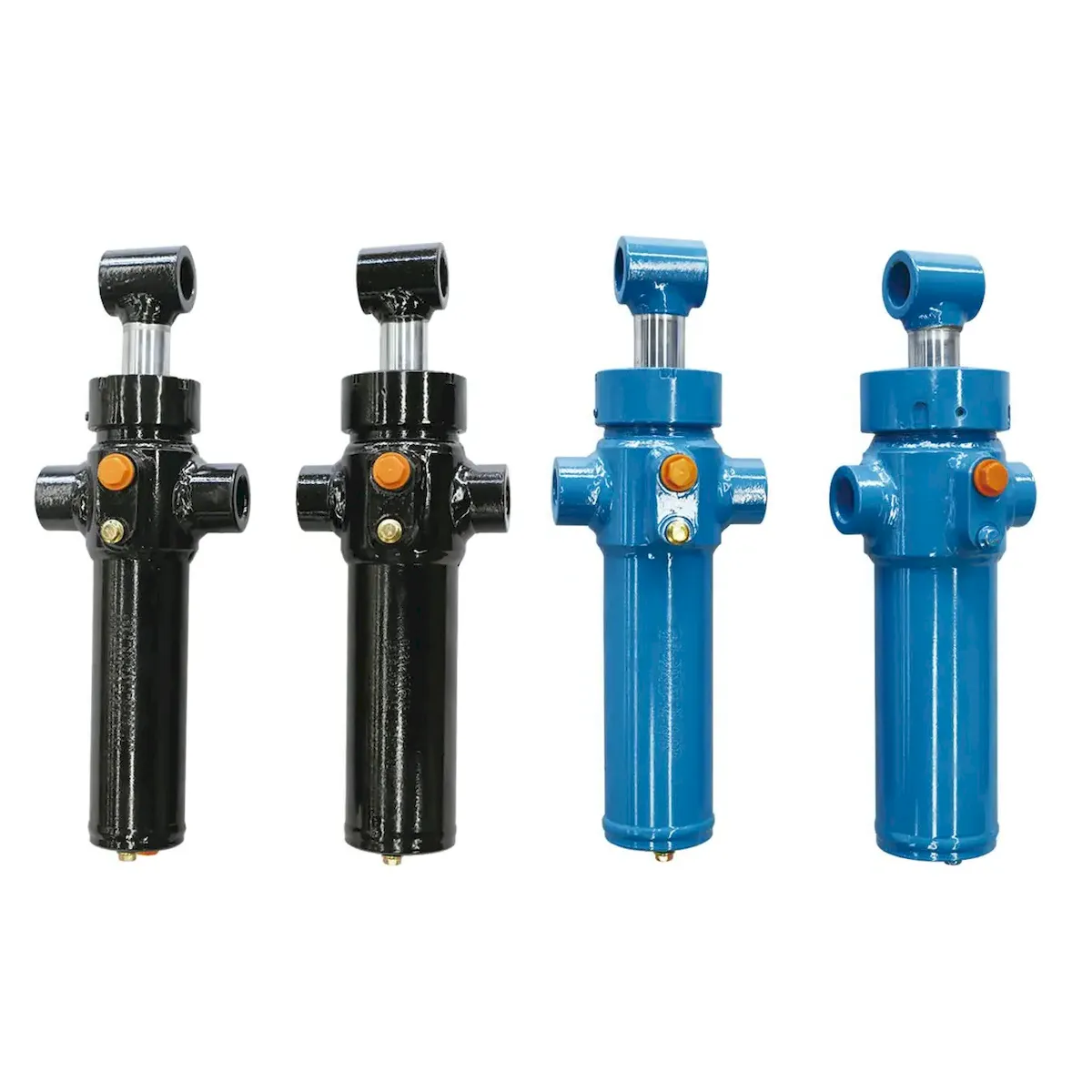
Vehicle workshop hoists use four primary cylinder architectures, each with a distinct bore, stroke, and circuit configuration:
TWO-POST
PLUNGER
Single-acting telescopic plunger cylinder per post. Bore 63–100 mm, stroke 1 600–2 000 mm, system pressure 12–18 MPa. Two cylinders in parallel share the vehicle load. Mechanical safety ladder (pawl-and-ratchet) on each column prevents descent if hydraulic pressure is lost — mandatory under EN 1493 and ALI (USA) certification. Each hoist lift cylinder must be sized so that one cylinder alone can support 75% of the rated hoist capacity to protect against catastrophic asymmetric loading.
FOUR-POST
COLUMN
Four single-acting lift cylinders, one per corner post, connected in a parallel hydraulic circuit. Bore 50–80 mm, stroke 1 400–1 800 mm. The runways span the vehicle and distribute load more evenly than a two-post design. Synchronisation maintained by a mechanical equalisation cable between front and rear runway cross-members — the cable compensates for small differences in cylinder extension speed and keeps the runway level without requiring electronic control. Used for vehicles up to 12 tonnes in commercial vehicle workshops.
IN-GROUND
SCISSOR
Single or twin short-stroke double-acting lift cylinders fitted below floor level in a concrete pit. Bore 80–160 mm, stroke 400–800 mm (scissor arm geometry multiplies vertical travel). Compact installed footprint — the floor surface is flush when the hoist is lowered. Popular in high-throughput tyre centres and alignment workshops. The hydraulic circuit requires careful anti-contamination design — the pit environment exposes the cylinder to water, brake dust, and cleaning chemicals.
MOBILE
COLUMN
Self-contained battery-powered column units, each with an integrated lift cylinder and hydraulic power unit. Typically used in sets of 4–6 for commercial vehicles and buses. Bore 80–120 mm. Each column operates independently but is synchronised electronically with the other columns via wireless communication — all columns must remain within a defined height tolerance (typically ±30 mm) throughout the lift cycle. The most complex synchronisation requirement of any vehicle hoist configuration.
ABSCHNITT 02
Two-Post Hoist Cylinders — Bore, Stroke and Synchronisation
The two-post vehicle hoist uses a single telescopic plunger lift cylinder in each column — the longest-stroke and most slender lift cylinder in any fixed-installation automotive application. These cylinders must extend perfectly synchronised to prevent the vehicle from tilting, despite being connected only by a hydraulic parallel circuit with no mechanical equalisation:
BORE SIZING
Each lift cylinder must support 50% of the vehicle weight at rated capacity. For a 4 000 kg hoist: each cylinder supports 2 000 kg = 19 620 N. At 16 MPa: D = √(4 × 19 620 / π × 16 000 000) = 39.6 mm minimum bore. With 2.0× safety factor: 56 mm — rounded to standard bore of Ø 63 mm. The 63 mm bore is standard for 3.5–4.0 t capacity passenger car hoists; Ø 80 mm is used for 5.0–5.5 t capacity.
SYNCHRONISATION
Two-post hoist lift cylinders are synchronised by a mechanical cable-and-pulley system running across the base of the hoist — as one column’s carriage rises, the cable pulls the other carriage to match. This mechanical system corrects for hydraulic flow imbalance between the two lift cylinders and maintains synchronisation regardless of asymmetric loading. Maximum permitted height difference between carriages when the lift cylinders are in motion: 25 mm per EN 1493. If the synchronisation cable breaks or stretches, the hydraulic parallel circuit alone cannot maintain adequate height matching.
STROKE AND TRAVEL
Total lift height of a two-post hoist is typically 1 800–2 100 mm above floor level. With a single-stage plunger, the cylinder stroke equals the total lift height — requiring a 1 800–2 100 mm plunger stroke in a compact bore. The slenderness ratio (stroke-to-bore) of these plunger cylinders is extremely high — 25:1 to 30:1 — which means the plunger surface finish and guide bearing quality are critical to preventing lateral deflection that causes seal wear.
Replacement two-post vehicle hoist lift cylinders matched to all major brands — Rotary, BendPak, Forward, Ravaglioli, Nussbaum — are available in the Hubzylinder product range. Provide the hoist brand, model, column width, and existing plunger bore and stroke to ensure a dimensionally identical replacement.
ABSCHNITT 03
Four-Post and Scissor Hoist Cylinders
Four-post hoists and in-ground scissor hoists each present specific cylinder specification requirements determined by their structural geometry and load distribution:
| PARAMETER | FOUR-POST | IN-GROUND SCISSOR | MOBILE COLUMN |
|---|---|---|---|
| Bohren | 50–80 mm | 80–160 mm | 80–120 mm per column |
| Schlaganfall | 1 400–1 800 mm | 400–800 mm | 1 400–1 800 mm |
| Sync method | Mechanical equaliser cable | Rephasing ports (twin) | Wireless electronic sync |
| Circuit type | Single-acting parallel ×4 | Double-acting ×1 or ×2 | Single-acting per column |
| Critical spec | Matched bore tolerance ±0.02 mm between 4 cylinders | Corrosion-resistant pit spec | Position feedback sensor integration |
ABSCHNITT 04
Safety Systems — Load-Hold, Mechanical Lock, EN 1493
EN 1493 (Vehicle lifts — safety requirements) mandates specific safety provisions for every vehicle hoist hydraulic circuit. These requirements apply to both new hoists and to hoist cylinder replacements — a replacement that does not maintain the original lift cylinder safety system integrity renders the hoist non-compliant:
MECHANISCH
SAFETY LOCK
Every vehicle hoist column must have a positive mechanical safety device that automatically engages at each lift height increment and prevents the carriage from descending if hydraulic pressure is lost. The pawl-and-ratchet ladder system on two-post hoists and the safety nut on telescopic single-post hoists are examples. EN 1493 requires that the mechanical lock can support the rated hoist capacity at any height position without hydraulic assistance. The hydraulic circuit drives the lift cylinder; the mechanical lock is the life-safety device.
LOAD-HOLD
VALVE
A pilot-operated check valve or equivalent load-holding device must be at each lift cylinder port. EN 1493 Section 5.3 requires that the vehicle does not descend more than 25 mm in 10 minutes under rated load with controls in neutral and the safety lock released. A hoist that passes the full EN 1493 drift rate test at commissioning and then fails it at the annual inspection has a deteriorating piston seal or POCV — both require replacement before continued use.
VELOCITY
FUSE
EN 1493 requires a velocity fuse in the circuit — a device that closes automatically if the platform descends at more than the maximum controlled lowering speed (typically set at 2–3× normal lowering speed). The velocity fuse provides emergency stopping if both the POCV and piston seal fail simultaneously — the hoist body is caught before it reaches the floor by the velocity fuse cutting the flow. Without a functional velocity fuse, a seal and valve failure combination would result in uncontrolled descent.
For industrial-grade vehicle hoist lift cylinders meeting EN 1493 requirements with integrated POCV port options and velocity fuse compatibility, the Hydraulikzylinder im Industriebau range provides configurations with the applicable valve integration and EN 1493 drift-rate documentation.
ABSCHNITT 05
Seal Specification and Contamination Control
The vehicle workshop environment presents specific seal compatibility challenges that differ from standard industrial applications. The contamination profile of an automotive workshop includes:
BRAKE DUST
Fine carbon and metallic particles from disc and drum brakes settle on the plunger rod and are drawn into the gland on retraction. A polyurethane dust wiper is more effective than NBR at excluding the fine brake dust particles that accumulate on a workshop floor around a hoist in daily use.
SOLVENTS
Brake cleaner (chlorinated or acetone-based) sprayed near the hoist column base directly contacts the plunger rod. Standard NBR seals swell in contact with chlorinated solvents within hours. FKM (Viton) seals provide excellent solvent resistance. Where FKM is unavailable, frequent solvent exposure should be managed by keeping spray area clear of the hoist plunger.
WATER & DETERGENT
Pressure washing around and under a vehicle on a hoist directs water and detergent directly onto the plunger. The wiper must exclude water from reaching the rod seal — water in the hydraulic system accelerates corrosion of the bore and causes emulsification of the hydraulic oil. After any pressure washing, inspect for water ingress by checking oil appearance — milky oil indicates water contamination requiring immediate fluid change.
ABSCHNITT 06
Service and Replacement Schedule
Vehicle hoists are required by law in most jurisdictions to undergo annual inspection by a competent person. The lift cylinder is a key lift cylinder inspection item at each annual service:
MONTHLY
Visual inspection of all plunger rod surfaces for oil seepage at the gland — any oil weeping at the gland entry requires seal inspection within 2 weeks. Check hydraulic oil level in HPU reservoir. Verify that the mechanical safety lock engages cleanly at each ratchet position by operating the hoist through 3–4 position increments and observing the pawl engagement.
JÄHRLICH
Full EN 1493 inspection by a competent person: static load test at 125% rated capacity, drift rate measurement (≤25 mm/10 min at rated load with controls neutral), synchronisation test (≤25 mm height difference between carriages), velocity fuse function test, and mechanical safety lock proof test. Replace hydraulic oil. If drift rate fails, replace cylinder seals and POCV before returning hoist to service. Issue inspection certificate.
EVERY 5 YEARS
Full lift cylinder seal replacement as preventive maintenance on all hoist positions — regardless of visible leakage. Chrome rod thickness measurement on two-post plunger cylinders. Hydraulic hose replacement (hoses degrade internally even without visible cracks). Synchronisation cable tension check and adjustment on four-post hoists. Any lift cylinder with bore damage, chrome below 15 μm, or structural deformation should be replaced rather than rebuilt in a high-throughput workshop environment.
Häufig gestellte Fragen zur Anwendung
Vehicle Hoist Cylinder Questions
Q01
One column on our two-post hoist is rising faster than the other — is this a lift cylinder problem or a control valve problem?
Speed imbalance between the two columns is almost always caused by a loose or broken synchronisation cable rather than a lift cylinder fault. The hydraulic circuit connects both cylinders in parallel with equal pressure — in the absence of a mechanical fault, both columns should rise at very similar speeds. If one column leads the other consistently, inspect the synchronisation cable first: look for a broken strand, a slack adjustment, or a pulley that has seized. A seized pulley allows one side to pull ahead unrestricted while the other side loses tension. Only if the synchronisation cable is intact and correctly tensioned should the lift cylinders themselves be investigated — check for a partially blocked flow control valve or a lifted wiper seal on the fast column that is causing it to move with less friction than the other.
Q02
Our vehicle hoist plunger has a faint chrome surface corrosion — can we continue using the hoist and how quickly does this affect the seal?
Light surface rust on a chrome plunger rod — the kind that wipes off with a cloth and leaves a faint orange stain — has already damaged the chrome surface at the microscopic level. Chrome oxide scale that separates from the plunger surface during extension passes through the dust wiper and reaches the rod seal, causing abrasive cutting of the seal lip. The seal may survive for weeks or months after visible surface corrosion appears, but each lifting cycle removes more chrome from the corroded areas and accelerates seal deterioration. The correct action is to assess the corrosion depth: if corrosion can be polished out with Scotch-Brite without creating a detectable groove, the plunger may continue in service with increased inspection frequency (weekly rather than monthly) and planned replacement within 3 months. If corrosion has created pitting deeper than can be polished out — confirmed by running a fingernail across the surface and feeling a step — the plunger of the lift cylinder requires re-chroming or replacement before the seal fails and allows the lift cylinder to develop a visible drift and gland leakage problem.
Frage 03
Can we fit a larger bore replacement cylinder to increase the lifting capacity of an older two-post hoist?
Not safely, and not without formal re-rating of the entire hoist structure by a certified inspection body. The hoist column, base plate anchors, and pivot pins — not just the lift cylinder — were all designed for the original rated capacity. Fitting a larger bore lift cylinder increases the hydraulic force available and allows heavier vehicles to be raised — but the structural components carrying that increased force have not been rated for it. A two-post hoist column above its design rating can fail by base plate deformation, anchor bolt pull-out, or column tube buckling — all of which result in the vehicle falling. The correct approach for capacity increase is to replace the entire hoist with a unit rated for the new capacity, or to have a structural engineer formally assess and certify the existing structure for the proposed new load rating before any hydraulic changes are made.
Q04
What is the difference between a hoist lift cylinder repair and a full replacement — which is the better value for a 10-year-old two-post hoist?
A vehicle hoist lift cylinder repair (seal kit replacement and gland re-assembly) is the correct choice when the plunger chrome surface is in good condition, the bore has no measurable enlargement from wear, and the structural integrity of the cylinder body is confirmed. A repair in this condition costs approximately 20–30% of a new cylinder and restores full seal performance. A full lift cylinder replacement is the better value when: the plunger chrome is corroded, scored, or below minimum thickness; the bore has enlarged beyond specification; the end-cap welds show rust blistering or cracking; or the repair would be the second or third in the cylinder’s life (indicating the bore or rod is approaching the end of its service cycle). For a 10-year-old two-post hoist used in a busy workshop (15–25 lifts per day), a full cylinder replacement at the 10-year point is typically more economical than a repair, because the total cost of seal kits and subsequent repairs usually exceeds the cost of a new direct-replacement lift cylinder. A new lift cylinder also resets the inspection clock and provides full warranty on the seal and structural components.
VEHICLE HOIST LIFT CYLINDER SUPPLY
Replacing a Vehicle Hoist Lift Cylinder?
Send us the hoist brand, model, column type, bore, and stroke — our team supplies a dimensionally matched replacement Hubzylinder with the correct seal specification for your workshop environment and EN 1493 compliance requirements.
Herausgeber: Cxm